I had the pleasure of being invited to a BYOB blind tasting at Elements in Princeton, NJ last week. Chris Cree and Joe Bembry of 56º Wine in Bernardsville, NJ orchestrated the tasting, and what a terrific evening it was. While the wines were excellent, the food really took center stage. This was my first visit to Elements and if the restaurant was not 75 minutes form my home, I would become a regular here. Scott Anderson, whose credits include the Ryland Inn, Les Copains, and Nova Terra, is the chef/owner and one of the most talented chefs I have ever encountered,. The Elements website accurately describes the food as Interpretive American Cuisine. As he says “our dishes are grounded in the essence of the ingredients”. At a time when many chefs are forcibly pushing the envelope with numerous ingredient combinations and unrestrained presentations, here the envelope is gently nudged resulting in a wonderful dinning experience.
Our group gave Mr. Anderson a free hand and he did not disappoint us. We began with two trios of Amuse-bouche. The initial trio consisted of a large ceramic spoonful of cold mushroom soup (superb), a Humus baguette (interesting) and a cheese & kale quiche (delicious).
The next trio began with Big Eye Tuna tartare made with scallion, ginger and white soy sauce. This was “off the chart”. It was so pristinely fresh, clean and tasty on the palate, I felt like asking if the rest of my meal could consist of this dish only. Fortunately sanity prevailed an I was able to enjoy the other two items in this round; Puff pastry with aged Gouda cheese (heavenly); squash stem stuffed with goat cheese (good, but ho-hum compared to everything else.
Raw fish returned with the next course in the form Kindai Madai, which I am told is a Japanese tuna that is entirely fed by humans. It was sliced thin and prepared with a wakame (an edible brown seaweed) puree, borage (salad green), apple and cucumber. The freshness of the perfectly balanced ingredients soared on the palate. A Remarkable dish.
Next came perfectly seared scallops in a chilled yellow squash soup. The combination of flavors, textures and temperatures played together like a Rogers and Hart musical composition. I took it in, sat back and enjoyed each spoonful.
Halibut with macadamia nut purée & carrot appeared next. Perfectly cooked, the fish danced on the tongue and tantalized the taste buds.
From the sea we moved to the land with incredibly juicy slices of Guinea hen served with smoked ham and tarragon. Wows could be heard around the table as this dish was consumed.
The final dish consisted of slices of Waygu beef brisket with a chile pepper puree. The dish was perfectly cooked, artfully presented and delicious on the palate.
We finished the evening with an assortment of cheeses, which I must say were the only weak spot of the evening.
As I mentioned in the opening of this blog this was a BYOB tasting in which the 7 attendees each bought a bottle of red and white wine. I was the only non-wine industry person at the event. Everyone else worked in the industry, so as you might imagine the wines were quite interesting and good. I must mention before going into the wines that I have never been a fan of blind tastings. I really don’t get their purpose. For me wine is meant to be drunk so that it may be enjoyed and experienced, not as some sort of test or guessing game as to grape, year, producer, etc. To quote the well-known and respected wine importer Kermit Lynch, “Blind tastings are to wine what strip poker is to love.” In any case the wines for the most part were quite good. While I was familiar with all the wine varieties, six of the producers were new to me. Getting to taste the wines of new producers is what I enjoy most about tastings, blind or not. I was not disappointed.
The evening began with a magnum of 1993 Vilmart et Cie Coeur de Cuvee, a barrel aged grand cru champagne that was gorgeous. This was not tasted blind. This was my first experience with this producer but it will not be my last. The wine had terrific balance and purity. It had a toasty elegance on the palate with a lengthy finish. One of the best champagnes I have ever had. Current vintages of this wine will cost you about $100 for a 750ml bottle.
The Blind Whites
2004 Domaine de la Pepiere Muscadet de Sevre et Maine Sur Lie Clos des Briords (melon de borgogne). Melon de Bourgogne or Melon is a variety of white grape grown in the Loire Valley region of France and best known through its use in Muscadet. The wine was soft and pure and went wonderfully with the tuna tartare. One of the great things about Muscadet is that they represent a fantastic bargain at about $15 a bottle. This vintage is probably long gone, but current vintages are worth trying, especially with oysters.
2009 Dr Heger Pinot Gris Sonett Trocken from Baden, Germany was next up. This producer was also new to me. The wine was young and crisp on the palate. A good inexpensive white at $24.
2009 Donnhoff Niederhauser Hermannshohle Riesling Trocken Grosses Gewachs followed. I am a big fan of Donnhoff Rieslings, especially the dry ones like this one. They are beautifully crafted examples of traditional wine making. I have this particular wine in my cellar and I had a bottle last year and while it was terrific it was still too young to really enjoy. It will benefit from more cellar time. This bottle was less terrific and still in need of cellar time. $68.
The fourth white was a 1995 Kalin Cellars Chardonnay Cuvee LD Sonoma, which I learned is the current release. The wine exhibited a pale yellow hue had good balance and despite the relatively high alcohol content and new French oak (Barrique?) aging it was not the oaky massive fruit bomb one usually gets from California. The wine was quite good, especially for 16 years of age. The wine pleasantly surprised me. $35.
Next came 2006 Jean-Michel Guillon Santenay "Les Bras". Traditionally made this beautiful Chardonnay drank very well. Nice balance and purity. $53.
The final white was a 1997 Jean Louis Chave Hermitage Blanc. When it comes to white wine from Hermitage, no one does it better than Jean Louis. If you have never had his wines, they are worth the price to experience perfection in a glass. Made from 100% Marsanne, this Northern Rhone beauty absolutely soared from the glass. A full-bodied wine that was round and delicious and was the consensus wine of the evening. $145.
The Blind Reds
Our first red of the evening was a 2001 Littorai Pinot Noir Thieriot Vineyard, from the Sonoma Coast. A wine for those who like California's modern approach to wine making. Wines like this taste "manufactured" to me as opposed to being an expression of the pureness of the grape. In addition this particular bottle tasted “tired” to me. Not a lot going on here. $55.
A 1996 Domaine Joseph Roty Gevrey Chambertin les Fontenys was next up. This premier cru wine is from one of Burgandy’s top producers. The Roty family have been working their vineyards for more than 300 years, so as you can imagine some of their wines come from some of the oldest vines in all of Burgundy. Production is very small, especially for their Grand Cru wines. This wine exhibited an earthy bouquet and a feminine elegance that I love about wines from this area. The wine would have benefited, in my opinion, had it had been decanted for a couple of hours. $65
One of my favorite Burgundy producers was up next. The 1990 Domaine de Montille Pommard Rugiens 1er Cru was delicious, but in my opinion still a baby that needs more time in the bottle. It possessed all the underlying elements of a great Burgundy, balance, complexity, purity and finish. My guess is that if this too had been decanted it would have been the wine of the evening. I’d love to have some in my cellar, but at $375 a bottle I will make do with the 2006 of this producer’s wine at $92.
For the next wine we remained in France, but traveled to the Loire for a terrific bottle of 1990 Olga Raffault Chinon Picasses. I really enjoy wines from the Chinon area and this was no exception. This is a new producer for me and one I will look to add to my cellar. As with all red wines from the Chinon this is made with 100% Cabbernet Franc. The wine was just superb, exhibiting great purity, complexity and a sense of place. The wine evolved with each sip. $55.
The next wine found us in the Duoro area of Portugal with a 2008 Niepoort Charme Tinto Douro, a blend of Tinta Roriz, Touriga Franca & other grapes. The wine is aged for 16 months in French oak. I did not like this at all. Very modern on the palate. The wine lacked soul and is very pricey at $100.
On to Italy and Piedmont with a 1999 Roagna Barbaresco Riserva Crichet Paje. Luca Roagna is one of my favorite old world wine makers. All his wines are filled with terroir and are wonderful expressions of the Nebbiolo grape. The Riserva Crichet Paje is, I believe, his top wine and this bottle was great. Round, delicious and with a sense of place. A wine with soul. Worth the $185 it will cost you. Of course you can delight your self with less expensive Barolos, Barbarescos, Dolcettos & Barberas from him. You will not be disappointed.
Back to France and the Northern Rhone for another beauty from JL Chave a 1995 Chave Hermitage Rouge. Terroir driven, full of pepper and spice, soft & elegant on the palate with a long, luscious finish. The wine kept evolving in the glass. Unfortunately wines of this caliber do not come cheap. Expect to pay $325 if you can find some.
I have often been asked that if I could have only one producer’s wines in my cellar who would that be? My response is always immediate and it is always Giuseppe Quintarelli. For me he is the master of traditional wine making anywhere. Since he lives in the Veneto, he makes Valpolicella and Amarones. No one des it any better. Our final wine was a 1999 Quintarelli Valpolicella. I have had this wine on many occasions and I marvel at it each time. It is a complete wine experience. Throw out all the adjectives when you drink his wines and suffice it to say they, like this bottle, are round and delicious. $75. BTW this was the only wine I could accurately name in the tasting.
The final wine of the night, not served blind, was 2005 Climens Sauternes that Gino graciously bought. From a terrific vintage the wine shows lots of tropical fruit and has a long candy-like finish. A superb dessert wine. $80.
All in all a great evening.
Until next time,
Saluté
BTW many of these wines can be purchased at 56º Wine in Bernardsville, NJ if you are interested.
Monday, July 11, 2011

Wednesday, June 22, 2011
Carol's Birthday
We had originally planned to celebrate my lovely wife Carol’s birthday by having a barbeque at our home. Unfortunately Mother Nature was not in a very cooperative mood and so we decided to move the celebration to Mei’s Café on Glenridge Ave. in Montclair, NJ. We were joined by our 2 girls, 3 grandchildren and Carol’s mother and brother. As you might imagine, under penalty of death I am not allowed to divulge her age, however if I did you would not believe me, as she looks wonderfully younger than her years. She is the same beauty I married 42 years ago.

Next to Italian food, it is safe to say that our family, especially our girls Gina & Lisa, are immensely fond of Asian cuisine. The newest addition to the Asian scene in Montclair is the above-mentioned Mei’s Café, and what an addition it is. Chef/owner Mei-Mei-La is awing her customers with Pan Asian cuisine specializing in dumplings, noodles, & rice dishes. These are authentic, homemade items that will have you licking your chopsticks. I suggest you start with a selection from the more than 10 dumplings on the menu, including daily specials like Shrimp & Pineapple Dumplings. And what’s more you may order these dumplings fried, pan-fried, steamed or in soup (Bonito broth). Each preparation has its own character, but I must admit that those in soup are my favorites, especially when the soup is the bath for her remarkably light & wonderfully spicy Shrimp & Jalapeno Dumplings.
On this occasion we began with pan-fried Pork & Cabbage Dumplings, Steamed Vegetable Dumplings, Steamed Beef & Jalapeno Dumplings and of course my favorite, Shrimp & Jalapeno Dumplings in soup. The dumplings are served with 3 sauces, mild, medium and a seductively hot Jalapeno sauce. We also savored spiced to perfection Chicken Satay and Wasabi Crab Cakes.

Main courses, which are the equal to the dumplings, consisted of Pad Thai, that my daughter Gina said was the best she ever had; Orange Teriyaki Chicken that my daughter Lisa could not stop raving about. Receiving the same accolades from the rest of our group was Sambal Chicken, a wonderfully spicy chicken dish; Clay Pot Garlic-roasted Cod; Clay Pot Pepper Steak and Basil Fried Rice with Chicken. Even the grandkids got into the act, enjoying Chicken with Mixed Vegetables in a brown sauce.

Mei describes her café’s décor as minimalist & contemporary. It is a large open space with food the star. Less successful is the service, which I am sure will improve with time.
We enjoyed two outstanding and two good wines, which I opened in unison as preferences at the table varied. Since it was Carol’s birthday one of the wines was her favorite, 2009 Ceretto Arneis Blange. Arneis is a white grape variety found in the hills of the Roero in Piedmont, Italy. The Ceretto Arneis is crisp and refreshing on the palate, has a bit of a spritz to it on opening and consistently good. $25. Available at most wine shops.
The two other whites we enjoyed were Vouvrays from the Alsace region of France. Chenin Blanc is the grape in these beautifully crafted wines and I am completely enamored by it, especially when it is made by two of the region’s best producers. We started with a 2005 Philippe Foreau Vouvray Demi Sec Clos Naudin. This is a beautifully made wine. It exhibits elegance and perfect balance. The wine just soars in the glass and has a sumptuously long finish. It is still very young with a long life ahead. Not easy to find, but if you do it will be well worth the $43 price tag.
The other Vouvray was a 1985 Huet Clos du Bourg Moelleux 1ere Trie. What a magnificent wine. I wrote about this particular wine in my initial blog about my most memorable wines of last year. This bottle was once again memorable. If you did not know this wine was 26 years old, you would think it was years younger, not unlike my lovely wife Carol. On the nose it is a refined beauty with a marvelous complexity of fruity aromas. On the palate it is completely balanced, round and pure with a slight hint of botrytis and a long and sensual finish. This is a wine that lets you truly experience what wine can be about when made by a master. As we did not finish the bottle, I took it home, re-corked it and put it in my fridge. I finished it 3 days later and it was still crisp and pure. It had lost very little. 56º Wine, Bernardsville, NJ. $85
My son-in-laws prefer red wine, so I brought a 2003 Beaurenard Chateauneuf-du-Pape Cuvée Boisrenard. A nice CDP if you like the more modern style of these wines that many CDP producers have moved towards the past few years. Here they combine tradition with modern techniques that produces a more extracted and higher alcohol (14.9%) wine than the traditionalists. $60
Please note that the wine glasses here are very small, so if you are bringing a good wine that really needs the proper glass to be appreciated you would be wise to bring your own glasses.

Since the kids were getting a bit antsy, we moved the celebration to our house and serenaded Carol with the traditional "Happy Birthday".

Until next time,
Saluté

Next to Italian food, it is safe to say that our family, especially our girls Gina & Lisa, are immensely fond of Asian cuisine. The newest addition to the Asian scene in Montclair is the above-mentioned Mei’s Café, and what an addition it is. Chef/owner Mei-Mei-La is awing her customers with Pan Asian cuisine specializing in dumplings, noodles, & rice dishes. These are authentic, homemade items that will have you licking your chopsticks. I suggest you start with a selection from the more than 10 dumplings on the menu, including daily specials like Shrimp & Pineapple Dumplings. And what’s more you may order these dumplings fried, pan-fried, steamed or in soup (Bonito broth). Each preparation has its own character, but I must admit that those in soup are my favorites, especially when the soup is the bath for her remarkably light & wonderfully spicy Shrimp & Jalapeno Dumplings.
On this occasion we began with pan-fried Pork & Cabbage Dumplings, Steamed Vegetable Dumplings, Steamed Beef & Jalapeno Dumplings and of course my favorite, Shrimp & Jalapeno Dumplings in soup. The dumplings are served with 3 sauces, mild, medium and a seductively hot Jalapeno sauce. We also savored spiced to perfection Chicken Satay and Wasabi Crab Cakes.

Main courses, which are the equal to the dumplings, consisted of Pad Thai, that my daughter Gina said was the best she ever had; Orange Teriyaki Chicken that my daughter Lisa could not stop raving about. Receiving the same accolades from the rest of our group was Sambal Chicken, a wonderfully spicy chicken dish; Clay Pot Garlic-roasted Cod; Clay Pot Pepper Steak and Basil Fried Rice with Chicken. Even the grandkids got into the act, enjoying Chicken with Mixed Vegetables in a brown sauce.

Mei describes her café’s décor as minimalist & contemporary. It is a large open space with food the star. Less successful is the service, which I am sure will improve with time.
We enjoyed two outstanding and two good wines, which I opened in unison as preferences at the table varied. Since it was Carol’s birthday one of the wines was her favorite, 2009 Ceretto Arneis Blange. Arneis is a white grape variety found in the hills of the Roero in Piedmont, Italy. The Ceretto Arneis is crisp and refreshing on the palate, has a bit of a spritz to it on opening and consistently good. $25. Available at most wine shops.
The two other whites we enjoyed were Vouvrays from the Alsace region of France. Chenin Blanc is the grape in these beautifully crafted wines and I am completely enamored by it, especially when it is made by two of the region’s best producers. We started with a 2005 Philippe Foreau Vouvray Demi Sec Clos Naudin. This is a beautifully made wine. It exhibits elegance and perfect balance. The wine just soars in the glass and has a sumptuously long finish. It is still very young with a long life ahead. Not easy to find, but if you do it will be well worth the $43 price tag.
The other Vouvray was a 1985 Huet Clos du Bourg Moelleux 1ere Trie. What a magnificent wine. I wrote about this particular wine in my initial blog about my most memorable wines of last year. This bottle was once again memorable. If you did not know this wine was 26 years old, you would think it was years younger, not unlike my lovely wife Carol. On the nose it is a refined beauty with a marvelous complexity of fruity aromas. On the palate it is completely balanced, round and pure with a slight hint of botrytis and a long and sensual finish. This is a wine that lets you truly experience what wine can be about when made by a master. As we did not finish the bottle, I took it home, re-corked it and put it in my fridge. I finished it 3 days later and it was still crisp and pure. It had lost very little. 56º Wine, Bernardsville, NJ. $85
My son-in-laws prefer red wine, so I brought a 2003 Beaurenard Chateauneuf-du-Pape Cuvée Boisrenard. A nice CDP if you like the more modern style of these wines that many CDP producers have moved towards the past few years. Here they combine tradition with modern techniques that produces a more extracted and higher alcohol (14.9%) wine than the traditionalists. $60
Please note that the wine glasses here are very small, so if you are bringing a good wine that really needs the proper glass to be appreciated you would be wise to bring your own glasses.

Since the kids were getting a bit antsy, we moved the celebration to our house and serenaded Carol with the traditional "Happy Birthday".

Until next time,
Saluté
Saturday, June 4, 2011
Mother's Day 2011
Mother’s Day dinner this year was spent with family and very good friends at Il Capriccio Ristorante in Whippany, NJ. I have lauded the food here in previous blogs and this occasion was equal to previous meals. As my waistline has been expanding lately, I have been eating less these days (8lbs less to date). So I limited myself to Calamari “Affogati”, a magnificent dish in which tender calamari are stewed with spring peas in a tomato and basil sauce. It is light and full of the flavor of the sea.
When I arrived at the restaurant owner/chef Tony Grande was having dinner with his family. As I wished them a happy Mother’s Day I could not help but notice that they were enjoying spaghetti and meatballs. It looked and smelled so good, that my entrée choice was made on the spot. I was glad I did. A beautifully simple dish made with quality ingredients.
Other dishes that were enjoyed that day included Vitello Tonato, a poached loin of veal, thinly sliced and served with a creamy tuna and caper infused mayonnaise; stuffed artichoke hearts; Scrigno di Mare, a wonderful combination of shelled lobster, prawns and day boat scallops with oyster mushrooms in a “Salsa Americaine” and Beef Short Ribs “Stracotto”, slow cooked boneless “Piemontese” beef short rib “Al Vino Rosso” served with risotto alla Parmiggiana with English peas.
Food like this cries out for great wine and I am happy to report that our selections did not disappoint. We began with a 2001 Ronchi di Cialla Ciallabianco from magnum. This is a beautifully crafted white wine made from the native grape varieties and native yeasts of Friuli Venezia. A blend of Ribolla Gialla, Verduzzo Friuliano and Picolit, the wine has a wonderful freshness and exhibits an amazing bouquet & palate of candy but without the sweetness. It is beautifully balanced, round and delicious on the palate with an elegant finish. $55/$119. 56º Wine, Bearnardsville, NJ
For reds we began with one of my very favorite wines and in my opinion one of the greatest wines ever made, the 1990 Edoardo Valentini Montepulciano d’Abruzzo. Valentini’s wines are amongst the most beautifully crafted wines you will ever find. Decanted for 4 hours the wine began to open in the final hour and display its beauty. Completely round and delicious. It is one of those great wines that are hard to explain and must be tasted to appreciate. Sergio Esposito, owner of Italian Wine Merchants in NYC says on their web site, “Edoardo Valentini was known locally as the “Lord of the Vines.” This resolute old-timer disregarded all modern conventions and wrapped his operations in a shroud of mystery, fervently guarding his production techniques from outsiders. His Trebbiano takes on uncommon colors, aromas, depth, complexity, and ability to age. Valentini's wines display a startlingly natural character, their individual quirks only enhancing their profound charm. Taking years to develop their full profile, the wines often need plenty of aeration to blow off the occasional hint of reduction. This all falls perfectly in step with one of Valentini's favorite lines, Natura non facit saltus or “Nature doesn't leap.” Valintini wines do not come cheap and are not easy to find, especially the 1990. If you do find it expect to pay $150 to $200 a bottle.
Next we moved onto a 1990 Quintarelli Amarone. I have lauded Quintarelli wines in previous blogs and this bottle was flat out awesome. Quintarelli’s ability to integrate the underlying sweetness of Amarone in these wines is just amazing. Balanced, pure, complex and with a remarkable finish it is a wine you think about for days after drinking. Round and soulful. Very expensive. Fortunately my good friend Gino who brought the wine had purchased it many years ago for much less than the $700 price tag the wine has now.
Quintarellli again delighted our palate and senses with the next bottle, a 1997 Alzero. I have had this wine on a number of occasions over the past few years and the experience is always memorable. It is made from 100% Cabernet Franc and in the same method as Amarone. As I have said before there are simply no words to explain it. It must be tasted to be experienced and appreciated. $350.
We closed out this terrific day with two great dessert wines, beginning with a 350 ml bottle of Quintarelli 1997 Bianco Amabile del Cere Bandito. The wine is made from grapes (Garganega, Trebbiano & Saorin) that have been "attacked" by "noble rot" ala Sauternes. Very rare, the wine has only been released a few times during Quintarelli’s lifetime. The wine is only produced in great vintages and is then “banished” as the name “Bandito” suggests. It possesses a seamless balance of tannins, acidity and sweetness. In short it is a profound dessert wine. $240. De-Vino Wine Boutique in NYC carries an amazing selection of Quintarelli wines including the Amabile.
The second bottle of dessert wine was a 2003 Chateau Climens Sauternes that was amazing. From a great vintage, the wine showed wonderful balance and a candy-like finish. As good, no as great as this wine was, it was, in my opinion simply no match for the Amabile. $90.
When you drink wines like these you you are rewarded with a remarkable wine experience. They seem to transport you to where they were made.

Until next time,
Saluté
When I arrived at the restaurant owner/chef Tony Grande was having dinner with his family. As I wished them a happy Mother’s Day I could not help but notice that they were enjoying spaghetti and meatballs. It looked and smelled so good, that my entrée choice was made on the spot. I was glad I did. A beautifully simple dish made with quality ingredients.
Other dishes that were enjoyed that day included Vitello Tonato, a poached loin of veal, thinly sliced and served with a creamy tuna and caper infused mayonnaise; stuffed artichoke hearts; Scrigno di Mare, a wonderful combination of shelled lobster, prawns and day boat scallops with oyster mushrooms in a “Salsa Americaine” and Beef Short Ribs “Stracotto”, slow cooked boneless “Piemontese” beef short rib “Al Vino Rosso” served with risotto alla Parmiggiana with English peas.
Food like this cries out for great wine and I am happy to report that our selections did not disappoint. We began with a 2001 Ronchi di Cialla Ciallabianco from magnum. This is a beautifully crafted white wine made from the native grape varieties and native yeasts of Friuli Venezia. A blend of Ribolla Gialla, Verduzzo Friuliano and Picolit, the wine has a wonderful freshness and exhibits an amazing bouquet & palate of candy but without the sweetness. It is beautifully balanced, round and delicious on the palate with an elegant finish. $55/$119. 56º Wine, Bearnardsville, NJ
For reds we began with one of my very favorite wines and in my opinion one of the greatest wines ever made, the 1990 Edoardo Valentini Montepulciano d’Abruzzo. Valentini’s wines are amongst the most beautifully crafted wines you will ever find. Decanted for 4 hours the wine began to open in the final hour and display its beauty. Completely round and delicious. It is one of those great wines that are hard to explain and must be tasted to appreciate. Sergio Esposito, owner of Italian Wine Merchants in NYC says on their web site, “Edoardo Valentini was known locally as the “Lord of the Vines.” This resolute old-timer disregarded all modern conventions and wrapped his operations in a shroud of mystery, fervently guarding his production techniques from outsiders. His Trebbiano takes on uncommon colors, aromas, depth, complexity, and ability to age. Valentini's wines display a startlingly natural character, their individual quirks only enhancing their profound charm. Taking years to develop their full profile, the wines often need plenty of aeration to blow off the occasional hint of reduction. This all falls perfectly in step with one of Valentini's favorite lines, Natura non facit saltus or “Nature doesn't leap.” Valintini wines do not come cheap and are not easy to find, especially the 1990. If you do find it expect to pay $150 to $200 a bottle.
Next we moved onto a 1990 Quintarelli Amarone. I have lauded Quintarelli wines in previous blogs and this bottle was flat out awesome. Quintarelli’s ability to integrate the underlying sweetness of Amarone in these wines is just amazing. Balanced, pure, complex and with a remarkable finish it is a wine you think about for days after drinking. Round and soulful. Very expensive. Fortunately my good friend Gino who brought the wine had purchased it many years ago for much less than the $700 price tag the wine has now.
Quintarellli again delighted our palate and senses with the next bottle, a 1997 Alzero. I have had this wine on a number of occasions over the past few years and the experience is always memorable. It is made from 100% Cabernet Franc and in the same method as Amarone. As I have said before there are simply no words to explain it. It must be tasted to be experienced and appreciated. $350.
We closed out this terrific day with two great dessert wines, beginning with a 350 ml bottle of Quintarelli 1997 Bianco Amabile del Cere Bandito. The wine is made from grapes (Garganega, Trebbiano & Saorin) that have been "attacked" by "noble rot" ala Sauternes. Very rare, the wine has only been released a few times during Quintarelli’s lifetime. The wine is only produced in great vintages and is then “banished” as the name “Bandito” suggests. It possesses a seamless balance of tannins, acidity and sweetness. In short it is a profound dessert wine. $240. De-Vino Wine Boutique in NYC carries an amazing selection of Quintarelli wines including the Amabile.
The second bottle of dessert wine was a 2003 Chateau Climens Sauternes that was amazing. From a great vintage, the wine showed wonderful balance and a candy-like finish. As good, no as great as this wine was, it was, in my opinion simply no match for the Amabile. $90.
When you drink wines like these you you are rewarded with a remarkable wine experience. They seem to transport you to where they were made.

Until next time,
Saluté
Wednesday, May 18, 2011
Grandma DeRosa's Lasagna
Along with my passion for good wine is my passion for pasta, or macaroni as we called in when I was growing up in Newark, NJ. My preference for old world traditionally made wine is extended to my preference for food, especially pasta. Simple dishes made with fresh, quality ingredients ring my bell every time. And for me there was no better traditionally made macaroni than my grandmother’s homemade ravioli and lasagna (I once at 43 of her ravioli in one sitting).
My grandparents, like most of the Italians in our neighborhood, came from the Provence of Avellino, Italy and grandma’s cooking was steeped in the tradition of Avellino, especially for holidays like Easter Sunday. The aforementioned ravioli or lasagna were the center of the meal on these occasions. In my opinion these two pastas did not have then, nor now any peer. They were and still are tops amongst my favorite pastas. Typical of Neapolitan cooking these pastas had no meat filling. They were about the ricotta filling and the gravy (Sunday Sauce as it is known today). The gravy meat was served after the lasagna. Easter Sunday usually meant Lasagna, meatballs, sausage, braciole and salad.
I still remember with great fondness and anticipation watching grandma prepare the ricotta filling after she made the pasta. I was always rewarded with being able to scrape the bowl and finish every bit of the ricotta mixture when the lasagna was complete. The flavor and texture will always be amongst my fondest memories. My mother gave me grandma's recipe and I have been making the lasagna for years, especially for Easter Sunday. And keeping with tradition the entire family comes to our house for the sumptuous repast. In addition to the great food and wine, we are now blessed with 3 beautiful grandchildren to share the celebration with.

Grandma DeRosa's Lasagna Recipe
3 lb. ricotta, drained over night
shredded fresh mozzarella
a lot of Italian parsley, minced
grated pecorino romano cheese
6 large eggs
salt & pepper to taste
homemade lasagna noodles (preferred)
It is essential to drain the ricotta in a colander overnight to remove the excess water. If you do not the lasagna will be messy and runny.
Place ricotta in a colander and allow it to drain it’s water over 3 to 6 hours, or preferably over night. Mix ricotta, eggs, parsley, pecorino, salt and pepper until well incorporated. Adjust flavoring to your taste by adding more pecorino, salt and pepper as needed. Blanch lasagna noodles in boiling water for 1 minute and then remove to an ice bath. Using a 9 by 13 pan, put a layer of tomato sauce on the bottom of the pan. Place a layer of lasagna on top of the sauce. Cover the lasagna with a layer of ricotta mixture and a sprinkle of the shredded mozzarella. ladle more sauce on top of this layer. Repeat with 5 or 6 more layers. Ladle tomato sauce on top of the top lasagna noodle, sprinkle with romano cheese and bake in a 350 degree oven for 30 minutes. When done, allow lasagna to sit for 30 minutes so that it may set. It is essential to let the lasagna rest for 30 minutes so that it is nice and firm when you serve it. Serve with meat and additional tomato sauce.
I am getting ahead of myself. Let’s start with the antipasto, another holiday tradition. In addition to the usual suspects such as roasted peppers, fresh mozzarella, provolone, grilled artichokes, etc. Pizzagaina, the traditional Easter Pie, makes an appearance. I purchased the Pizzagaina this year at Buono’s Prime Meats and Deli in Little Falls NJ. Owner Jimmy told me it is made in Brooklyn and he has been purchasing it for more than 15 years. It was truly outstanding…one of the best I have ever had. It had a great moist texture and the meat and cheeses complimented each other beautifully. A bit rich, but OOH so good. This year I also included Rock Shrimp Arrabiatta, easy to make and always a crowd pleaser. Thanks to Mario Carlino, chef/owner of Divina Ristorante, North Caldwell, NJ for the recipe.

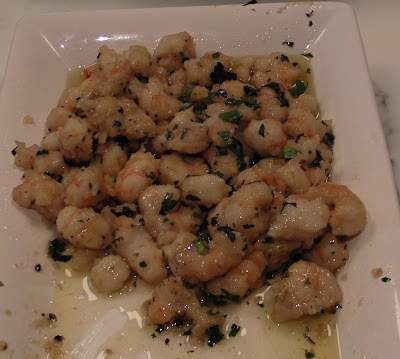
Rock Shrimp Arrabiata (Divina Ristorante)
1 lb rock shrimp
sliced fresh garlic
olive oil
vegetable oil for frying
flour
Clam juice
chicken broth
red pepper flakes
chopped fresh parsley
white wine
oregano
salt and pepper
Make sauce in a large skillet. Sauté garlic in olive oil for a couple of minutes, add white wine and reduce by 1/2. Depending on how many shrimp you have, add enough clam juice to make a sauce when fried shrimp are added. Add 1/4 cup chicken broth, oregano, salt and pepper.
Coat shrimp with flour, shaking off excess. Pre-heat a deep fryer set at 375º (if you have no fryer, heat vegetable oil in a large saucepan). Fry shrimp for 60 seconds in fryer, remove, shake off excess oil and add to skillet with sauce. Incorporate over medium heat for 30 seconds, add parsley and serve.
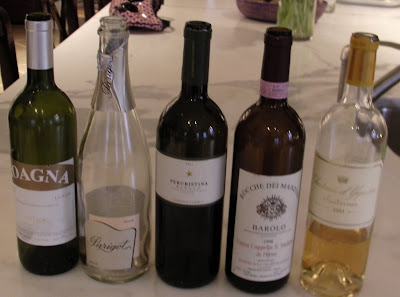
With the appetizers we had Non Vintage Parigot & Richard Cremant de Bourgogne Rosé. Since it is from Burgundy and not Champagne, the wine can not be called Champagne even though it is made in the traditional methode champagne manner. No matter what it's called, the wine is terrific. Lively and balanced on the palate it entices your taste buds. The finish is clean and pure, and at $17 a bottle an absolute steal. 56º Wine, Bearnardsville, NJ.
The main course consisted of the aforementioned lasagna with homemade gravy (called Sunday Sauce these days) meatballs, sausage and braciole. The white I choose here was a 2003 Roagna Langhe Bianco Solea. Roagna’s wines are steeped in traditional style wine making. While they are known for their incredible Barbarescos and Barolos, this white is an example of how delicious white wine can be. A blend of about 70% Chardonnay and white Nebbiolo that sees no skin contact during fermentation, it exhibits incredible purity on the palate with an elegant feminine finish. $26. Wine Legend, Livingston, NJ. Oh, one more thing, this is another Louis Dressner selection who I mentioned in my last blog.
For the red wines I opted for a comparison of old and new world. The new was represented by Domenico Clerico Barolo Per Cristina 2001, while the old was represented by 1996 Valentino Rocche Dei Manzoni Barolo Vigna Cappella Santo Stefano di Perno. Both wines were decanted for 3-4 hours.
Clerico pleasantly surprised me. I expected it to have a lot of oak due to Barrique aging, however the oak was well integrated and the wine was pleasant to drink. It was nicely balanced, showed layers of complexity and had a lengthy finish. What it did not have is the sense of place that a traditional Barolo has. It had no soul and at a hefty $150 - $200, dramatically over priced in my opinion.
The Valentino Rocche Dei Manzonni on the other hand was a beautiful crafted old world Barolo that exhibits an enticing bouquet on the nose with a lengthy finish. The wine is balanced, complex an wonderfully pure & elegant on the palate. The wine has soul and is delicious. It is drinking really well right now. $95. de-vino boutique, NYC.
For dessert I opened a 2003 Chateau d’Yquem Sauternes. While d’Yquem is not my favorite dessert wine, the 2003 is magnificent. I have had this wine on 3 occasions now and it has been spectacular each time. In fact, it may be the best d’Yquem I’ve tasted. It is full of tropical fruit such as bananas & pineapple and vanilla, and most importantly for me it lacks the medicinal finish as I usually experience with these wines, A simply delicious wine. Wines like this unfortunately do not come cheap. Expect to pay around $300.
Until next time,
Saluté
My grandparents, like most of the Italians in our neighborhood, came from the Provence of Avellino, Italy and grandma’s cooking was steeped in the tradition of Avellino, especially for holidays like Easter Sunday. The aforementioned ravioli or lasagna were the center of the meal on these occasions. In my opinion these two pastas did not have then, nor now any peer. They were and still are tops amongst my favorite pastas. Typical of Neapolitan cooking these pastas had no meat filling. They were about the ricotta filling and the gravy (Sunday Sauce as it is known today). The gravy meat was served after the lasagna. Easter Sunday usually meant Lasagna, meatballs, sausage, braciole and salad.
I still remember with great fondness and anticipation watching grandma prepare the ricotta filling after she made the pasta. I was always rewarded with being able to scrape the bowl and finish every bit of the ricotta mixture when the lasagna was complete. The flavor and texture will always be amongst my fondest memories. My mother gave me grandma's recipe and I have been making the lasagna for years, especially for Easter Sunday. And keeping with tradition the entire family comes to our house for the sumptuous repast. In addition to the great food and wine, we are now blessed with 3 beautiful grandchildren to share the celebration with.

Grandma DeRosa's Lasagna Recipe
3 lb. ricotta, drained over night
shredded fresh mozzarella
a lot of Italian parsley, minced
grated pecorino romano cheese
6 large eggs
salt & pepper to taste
homemade lasagna noodles (preferred)
It is essential to drain the ricotta in a colander overnight to remove the excess water. If you do not the lasagna will be messy and runny.
Place ricotta in a colander and allow it to drain it’s water over 3 to 6 hours, or preferably over night. Mix ricotta, eggs, parsley, pecorino, salt and pepper until well incorporated. Adjust flavoring to your taste by adding more pecorino, salt and pepper as needed. Blanch lasagna noodles in boiling water for 1 minute and then remove to an ice bath. Using a 9 by 13 pan, put a layer of tomato sauce on the bottom of the pan. Place a layer of lasagna on top of the sauce. Cover the lasagna with a layer of ricotta mixture and a sprinkle of the shredded mozzarella. ladle more sauce on top of this layer. Repeat with 5 or 6 more layers. Ladle tomato sauce on top of the top lasagna noodle, sprinkle with romano cheese and bake in a 350 degree oven for 30 minutes. When done, allow lasagna to sit for 30 minutes so that it may set. It is essential to let the lasagna rest for 30 minutes so that it is nice and firm when you serve it. Serve with meat and additional tomato sauce.
I am getting ahead of myself. Let’s start with the antipasto, another holiday tradition. In addition to the usual suspects such as roasted peppers, fresh mozzarella, provolone, grilled artichokes, etc. Pizzagaina, the traditional Easter Pie, makes an appearance. I purchased the Pizzagaina this year at Buono’s Prime Meats and Deli in Little Falls NJ. Owner Jimmy told me it is made in Brooklyn and he has been purchasing it for more than 15 years. It was truly outstanding…one of the best I have ever had. It had a great moist texture and the meat and cheeses complimented each other beautifully. A bit rich, but OOH so good. This year I also included Rock Shrimp Arrabiatta, easy to make and always a crowd pleaser. Thanks to Mario Carlino, chef/owner of Divina Ristorante, North Caldwell, NJ for the recipe.


Rock Shrimp Arrabiata (Divina Ristorante)
1 lb rock shrimp
sliced fresh garlic
olive oil
vegetable oil for frying
flour
Clam juice
chicken broth
red pepper flakes
chopped fresh parsley
white wine
oregano
salt and pepper
Make sauce in a large skillet. Sauté garlic in olive oil for a couple of minutes, add white wine and reduce by 1/2. Depending on how many shrimp you have, add enough clam juice to make a sauce when fried shrimp are added. Add 1/4 cup chicken broth, oregano, salt and pepper.
Coat shrimp with flour, shaking off excess. Pre-heat a deep fryer set at 375º (if you have no fryer, heat vegetable oil in a large saucepan). Fry shrimp for 60 seconds in fryer, remove, shake off excess oil and add to skillet with sauce. Incorporate over medium heat for 30 seconds, add parsley and serve.
With the appetizers we had Non Vintage Parigot & Richard Cremant de Bourgogne Rosé. Since it is from Burgundy and not Champagne, the wine can not be called Champagne even though it is made in the traditional methode champagne manner. No matter what it's called, the wine is terrific. Lively and balanced on the palate it entices your taste buds. The finish is clean and pure, and at $17 a bottle an absolute steal. 56º Wine, Bearnardsville, NJ.
The main course consisted of the aforementioned lasagna with homemade gravy (called Sunday Sauce these days) meatballs, sausage and braciole. The white I choose here was a 2003 Roagna Langhe Bianco Solea. Roagna’s wines are steeped in traditional style wine making. While they are known for their incredible Barbarescos and Barolos, this white is an example of how delicious white wine can be. A blend of about 70% Chardonnay and white Nebbiolo that sees no skin contact during fermentation, it exhibits incredible purity on the palate with an elegant feminine finish. $26. Wine Legend, Livingston, NJ. Oh, one more thing, this is another Louis Dressner selection who I mentioned in my last blog.
For the red wines I opted for a comparison of old and new world. The new was represented by Domenico Clerico Barolo Per Cristina 2001, while the old was represented by 1996 Valentino Rocche Dei Manzoni Barolo Vigna Cappella Santo Stefano di Perno. Both wines were decanted for 3-4 hours.
Clerico pleasantly surprised me. I expected it to have a lot of oak due to Barrique aging, however the oak was well integrated and the wine was pleasant to drink. It was nicely balanced, showed layers of complexity and had a lengthy finish. What it did not have is the sense of place that a traditional Barolo has. It had no soul and at a hefty $150 - $200, dramatically over priced in my opinion.
The Valentino Rocche Dei Manzonni on the other hand was a beautiful crafted old world Barolo that exhibits an enticing bouquet on the nose with a lengthy finish. The wine is balanced, complex an wonderfully pure & elegant on the palate. The wine has soul and is delicious. It is drinking really well right now. $95. de-vino boutique, NYC.
For dessert I opened a 2003 Chateau d’Yquem Sauternes. While d’Yquem is not my favorite dessert wine, the 2003 is magnificent. I have had this wine on 3 occasions now and it has been spectacular each time. In fact, it may be the best d’Yquem I’ve tasted. It is full of tropical fruit such as bananas & pineapple and vanilla, and most importantly for me it lacks the medicinal finish as I usually experience with these wines, A simply delicious wine. Wines like this unfortunately do not come cheap. Expect to pay around $300.

Until next time,
Saluté
Friday, May 6, 2011
A memorable old wine & a terrific young one
Teobaldo Cappellano was a gentle giant (He passed away in 2010 at much to early an age). I had the pleasure of meeting him when my wife and I visited his estate in 2008. A friend and terrific wine writer, Alice Feiring, first told me about “Baldo” and suggested that I visit him. She said I would love his wines as they are traditional and amongst the best Baroli you can find in Italy. She was right. I tasted his 2004 & 2005 from the barrel and they were wonderful expressions of old world wine making. The wines displayed incredible purity, balance and earthiness on the palate. They had soul. While I was very impressed with the wines, I was even more impressed by Baldo, a striking figure, well over 6 feet tall with a very mild, gentile and as I perceived sagacious manner. He spoke of the importance of quality ingredients prepared with simplicity, i.e. don’t mess with what Mother Nature has given us, rather help her to express it. His wines certainly underscored his comments. So I began to buy his wines and enjoy them. A few months ago I had an opportunity to purchase a few bottles of his 1964 Barolo from Chambers Street Wines. As providence would have it the day the wine arrived, my good friend Gino (who is in the wine business and is very knowledgeable regarding wine, especially old vintages) stopped by. The 1964 Cappellano Barolo was all I needed to convince him to join my wife and I at dinner that evening. Older bottles of wine are often a crapshoot. Well if this were craps, we kept rolling sevens and elevens. Upon opening, the wine had a rust brown hue as one expects from older wines. The nose and first sip enticed our senses. Within an hour, the rust brown was now a strawberry red that deepened as time passed, something neither of us have ever experienced before. In the second hour the wine became more translucent in color and on the palate it just soared. We were swooped up and transported to Piedmonte. Here was Mother Nature preserved for 47 years. The wine was simply delicious and awesome. It was easily the best old Barolo either of us has ever drunk. The wine continued to evolve with each sip bringing a new delight. This was truly a magnificent wine experience. I only wish I had purchased more than 3 bottles as there appear to me no more around. Fortunately his current wines are available and if you like the wines of Bartolo Mascarello, Giuseppe Rinaldi, Aldo Conterno, Giacomo Contero and Bruno Giacosa you would do well to add Cappellano to your cellar as his wines are of the same caliber.

Louis Dressner an importer of traditionally made wines is the importer of Cappellano wines. He also is the importer of the wines of Alice and Olivier de Moor from the Chablis region of Burgundy in France. Their wines are terrific and a great value. Prior to dinner we drank a 2007 De Moor Chablis Bel Air et Clardy. The wine showed a wonderful balance and purity on the palate with a lengthy citrus finish. $22. Available at Chambers Street Wines.
BTW, if you have not read Alice’s book The Battle for Wine and Love: or How I Saved the World from Parkerization, do yourself a favor and pick up a copy. It is a must read for any wine lover.
Until next time,
Saluté

Louis Dressner an importer of traditionally made wines is the importer of Cappellano wines. He also is the importer of the wines of Alice and Olivier de Moor from the Chablis region of Burgundy in France. Their wines are terrific and a great value. Prior to dinner we drank a 2007 De Moor Chablis Bel Air et Clardy. The wine showed a wonderful balance and purity on the palate with a lengthy citrus finish. $22. Available at Chambers Street Wines.
BTW, if you have not read Alice’s book The Battle for Wine and Love: or How I Saved the World from Parkerization, do yourself a favor and pick up a copy. It is a must read for any wine lover.
Until next time,
Saluté
Monday, April 25, 2011
A couple of lunches with good friends
Believe me when I tell you that most days I prefer a simple bowl of soup and a sandwich, burger or hot dog for lunch. However I am fortunate to have friends that not only share my passion for good food and wine, but also are also very persuasive in enticing me to break from this preference and indulge in a lunch with great food and great wine on occasion. Such was the case when Tony & Jack invited me to Il Capriccio Ristorante in Whippany, NJ in late February. I have lauded the food at Il Capriccio in previous blogs and this lunch was once again superb.
We began with manila clams in spicy white wine broth; perfectly cooked crustaceans in a sauce that demands that you sop up every last drop with good crusty Italian bread. A decanted bottle of 2003 Gravner Anphora Ribolla Gialla drank beautifully with the clams, but then again I have never had a bottle of Gravner that did not drink beautifully with whatever I was eating. Ribolla Gialla is a white grape from the Friuli Venezia region of Italy. Gravner is close to the Slovenian border in Gorzia, Italy. In my opinion he is one of the great winemakers in the world. Talk about Old Word traditional wines, here is one of the masters. His wines go through an extended fermentation in beeswax-lined clay amphorae, which are specially made for him and transported, from Georgia, Russia. The wine is then transferred to large barrels of Slovenian oak where it rests for another three years before bottling. The result is a magnificently pure wine that is a complete expression of nature. To quote the man ““I am convinced that wine is a product of Nature, not of Man, whose role therefore is to accompany its maturation process while avoiding any artificial intervention”. Amen.
His long maceration process of 7 to 8 months on the grape skins produces a wine with an absolutely gorgeous orange/yellow hue and mind-boggling complexity, balance and purity. THIS IS A WHITE WINE THAT IS MEANT TO BE DRUNK AT RED WINE TEMPERATURE. In fact the wine should be decanted for a minimum of 3-4 hours before drinking. If you drink this wine cold, you will miss it. The wine continues to evolve with each sip. It is a true wine experience. If you prefer your white wines very cold, skip this one. But I digress, well a bit any way. Back to the ’03 we drank. Two words describe it: stunning and delicious. Nothing else can or need be said. This is a wine with soul. (Did I just say something else/?)
On a side note, a while ago I met a close friend of Gravner (Joskel is his first name) who comes to the US periodically to promote the wines. He suggested that the next time I opened a bottle and did not finish it to put the cork back in and put it back in the wine cellar for a month, and then try it. Well I did, and I was amazed at how good the wine was. It had lost nothing. The wine was only slightly oxidized and had taken on a bit deeper orange hue, but was still perfectly balanced and delicious on the palate. $85.
Next up on the menu was homemade papparadelle pasta with a sauce of fresh capon. It was amazing. We had two reds with this. First was a 1998 Guigal Chateau d’Ampuis Cote-Rotie. 100% Syrah, this bottle was very good. It started out a bit tight, even after an hour of decanting. Began to open in hour 2. Nice pepper and spice and sense of place. Enjoyable now, but will definitely benefit from more cellar time. $95
Alongside this we had a 1996 Francesco Rinaldi Barolo Cannubbio that was just superb. Another traditional winemaker, Francesco’s wines a beautifully crafted. This bottle sang today. Glorious bouquet of the earth and the grape. Pure, complex and balanced on the palate, with a lengthy finish. The essence of old world Barolo. $80

A few weeks later, with friends Emil and Howard, found me having lunch at one of Montclair, NJ newest and hottest dinning spots, Salute Brick Oven Bistro on Glenridge Ave. Baccala cakes, pasta fagioli and rock shrimp arrabiatta are among my favorite items here and we had them all along with 3 fabulous wines.
We began with a 2001 Gravner Breg Anfora. The Breg is a blend of Sauvignon Blanc, Riesling Italico, Chardonnay & Pinot Grigio. It is made in the same manner as the Ribolla Gialla mentioned above. Again the wine was just superb. Pure and delicious on the palate with a lengthy finish. $85
Next up was a 1967 Angelo Gaja Barbaresco. I am not a big fan of Gaja wines. He has become more modern in his methods the past 10 years or so. He adds the Barbera grape (about 5%) to his Barbarescos. Since this does not conform to recent changes in Italian winemaking law in Piedmonte, he cannot put the word Barbaresco on the label. To be labeled a Barbaresco the law states that the wine must contain 100% Nebbiolo. I also find his current wines to be a bit over extracted. Add to this the very high price the Gaja name commands, I pass on his wines. The 1967 however was absolutely terrific. Probably made by Angelo’s father this was a beautiful example of an old world Barbaresco. Brownish red and a bit oxidized upon opening, the wine just kept evolving after being decanted. Within 30 minutes we knew we were in the presence of a spectacular wine and the next hour only confirmed. It showed a great sense of place. A wine with a great deal of soul. If Gaja made his wines today like this wine I would bite the bullet and pay the price. Thanks Emil for bringing this one.
The last wine (thank you Howard), 1994 Quintarelli Alzero is one of the great wines of all time. It is impossible to describe this wine other than to say it is completely round and delicious. The wine is made from predominantly Cabernet Franc and in the same method used to make Amarone, in which the grapes are dried for several months prior to vinification. The resulting wine is unbelievably rich in color and ethereal on the palate. A wine that provides a provocative wine tasting experience. I have had the 1996 and 1997 vintages of this wine and each is superb. Alas greatness does not come without a price. Expect to pay a price in the mid $300 range for this wine.

Allow me to close this blog with an old proverb (I believe Arabian) Emil sent me:
“Good wine praises itself”
Until next time,
Saluté
We began with manila clams in spicy white wine broth; perfectly cooked crustaceans in a sauce that demands that you sop up every last drop with good crusty Italian bread. A decanted bottle of 2003 Gravner Anphora Ribolla Gialla drank beautifully with the clams, but then again I have never had a bottle of Gravner that did not drink beautifully with whatever I was eating. Ribolla Gialla is a white grape from the Friuli Venezia region of Italy. Gravner is close to the Slovenian border in Gorzia, Italy. In my opinion he is one of the great winemakers in the world. Talk about Old Word traditional wines, here is one of the masters. His wines go through an extended fermentation in beeswax-lined clay amphorae, which are specially made for him and transported, from Georgia, Russia. The wine is then transferred to large barrels of Slovenian oak where it rests for another three years before bottling. The result is a magnificently pure wine that is a complete expression of nature. To quote the man ““I am convinced that wine is a product of Nature, not of Man, whose role therefore is to accompany its maturation process while avoiding any artificial intervention”. Amen.
His long maceration process of 7 to 8 months on the grape skins produces a wine with an absolutely gorgeous orange/yellow hue and mind-boggling complexity, balance and purity. THIS IS A WHITE WINE THAT IS MEANT TO BE DRUNK AT RED WINE TEMPERATURE. In fact the wine should be decanted for a minimum of 3-4 hours before drinking. If you drink this wine cold, you will miss it. The wine continues to evolve with each sip. It is a true wine experience. If you prefer your white wines very cold, skip this one. But I digress, well a bit any way. Back to the ’03 we drank. Two words describe it: stunning and delicious. Nothing else can or need be said. This is a wine with soul. (Did I just say something else/?)
On a side note, a while ago I met a close friend of Gravner (Joskel is his first name) who comes to the US periodically to promote the wines. He suggested that the next time I opened a bottle and did not finish it to put the cork back in and put it back in the wine cellar for a month, and then try it. Well I did, and I was amazed at how good the wine was. It had lost nothing. The wine was only slightly oxidized and had taken on a bit deeper orange hue, but was still perfectly balanced and delicious on the palate. $85.
Next up on the menu was homemade papparadelle pasta with a sauce of fresh capon. It was amazing. We had two reds with this. First was a 1998 Guigal Chateau d’Ampuis Cote-Rotie. 100% Syrah, this bottle was very good. It started out a bit tight, even after an hour of decanting. Began to open in hour 2. Nice pepper and spice and sense of place. Enjoyable now, but will definitely benefit from more cellar time. $95
Alongside this we had a 1996 Francesco Rinaldi Barolo Cannubbio that was just superb. Another traditional winemaker, Francesco’s wines a beautifully crafted. This bottle sang today. Glorious bouquet of the earth and the grape. Pure, complex and balanced on the palate, with a lengthy finish. The essence of old world Barolo. $80

A few weeks later, with friends Emil and Howard, found me having lunch at one of Montclair, NJ newest and hottest dinning spots, Salute Brick Oven Bistro on Glenridge Ave. Baccala cakes, pasta fagioli and rock shrimp arrabiatta are among my favorite items here and we had them all along with 3 fabulous wines.
We began with a 2001 Gravner Breg Anfora. The Breg is a blend of Sauvignon Blanc, Riesling Italico, Chardonnay & Pinot Grigio. It is made in the same manner as the Ribolla Gialla mentioned above. Again the wine was just superb. Pure and delicious on the palate with a lengthy finish. $85
Next up was a 1967 Angelo Gaja Barbaresco. I am not a big fan of Gaja wines. He has become more modern in his methods the past 10 years or so. He adds the Barbera grape (about 5%) to his Barbarescos. Since this does not conform to recent changes in Italian winemaking law in Piedmonte, he cannot put the word Barbaresco on the label. To be labeled a Barbaresco the law states that the wine must contain 100% Nebbiolo. I also find his current wines to be a bit over extracted. Add to this the very high price the Gaja name commands, I pass on his wines. The 1967 however was absolutely terrific. Probably made by Angelo’s father this was a beautiful example of an old world Barbaresco. Brownish red and a bit oxidized upon opening, the wine just kept evolving after being decanted. Within 30 minutes we knew we were in the presence of a spectacular wine and the next hour only confirmed. It showed a great sense of place. A wine with a great deal of soul. If Gaja made his wines today like this wine I would bite the bullet and pay the price. Thanks Emil for bringing this one.
The last wine (thank you Howard), 1994 Quintarelli Alzero is one of the great wines of all time. It is impossible to describe this wine other than to say it is completely round and delicious. The wine is made from predominantly Cabernet Franc and in the same method used to make Amarone, in which the grapes are dried for several months prior to vinification. The resulting wine is unbelievably rich in color and ethereal on the palate. A wine that provides a provocative wine tasting experience. I have had the 1996 and 1997 vintages of this wine and each is superb. Alas greatness does not come without a price. Expect to pay a price in the mid $300 range for this wine.

Allow me to close this blog with an old proverb (I believe Arabian) Emil sent me:
“Good wine praises itself”
Until next time,
Saluté
Thursday, April 7, 2011
Dinner at Nick & Caren's House
Nick Cusano and I became friends a number of years ago when I hired him to design our new home. As I got to know him I learned that not only was he a fantastic architect, Cusano Associates, but that we both shared a passion for cooking (and I might add eating). We became good friends. A couple of weeks ago we were invited to one of his many Saturday night dinners at his home along with some of his other friends. It was a great evening of food, wine and lively conversation.
Pre-dinner pickings included mozzarella de bufala, grilled sausage, hot peppers, Nick’s homemade foccia (the man is an incredible baker). Nick’s friend Tommaso is Nick’s equal in the bread-making arena and his baguettes were amazing. The recipe for his bread is from the book “My Bread” for those bakers out there who might be interested.
The pre-dinner wines included a magnum of 2004 William Fevre Chablis Montée de Tonnerre and a bottle of 2006 Riecine La Gioia . In my opinion, the best French Chardonnays come from the Chablis region and along with Raveneau, Fevre is one of the regions most outstanding traditional winemakers. I find the wines from Chablis to be much more elegant than those from Montrachet or Meursault. The Montée de Tonnerre is a Premier Cru wine with amazing freshness, minerality and purity. Absolutely round and delicious on the palate. At $45 per bottle, $110 per magnum, it is an outstanding value.
The Riecine La Giaia is a Super Tuscan, Sangiovese based wine that is blended from various vineyard parcels with different soil types which adds to the complexity of the wine. Dark garnet in color, it is a more modern style wine that drank very nicely, although, at least for me, the oak influence was a bit too pronounced. The wine had good balance and a soft finish, albeit a bit oaky. Around $50 a bottle. 56º Wine, Bearnardsville, NJ.
Dinner began with Italian Wedding Soup, my contribution to the menu. The recipe is from Lidia Bastianch’s new book “Lidia Cooks From The Heart of Italy”. It is a delicious soup brimming with flavor. I am happy to report that all enjoyed it. The recipe can also be found on Lidia’s website, Lidia's Italy.

Next up was a terrific pasta dish that Nick had learned from the Contessa Lelia Passi on his last trip to Venice, Italy. The Contessa studied under Mara Martin owner and chef of Da Fiore Ristorante in Venice. I had the pleasure of eating at Da Fiore a few years ago. The restaurant is among my “5 Best Restaurants in the World”. The seafood is pristinely fresh and must me tasted to appreciate. There really are no words for food like Mara Martin prepares. If you are in Venice, it is a must visit. In any case Nick’s pasta echoed the style of Da Fiore, simple and flavorful, it was a wonderful combination of scallops, onion, thyme and broccoli with penne pasta.
This was followed by a prosciutto wrapped filet mignon braised in a sauce of wild mushroom, onion, red wine and tomatoes. It was served over a bed of soft polenta. Cooked to perfection, it was tender and juicy. Simply delicious.

With these dishes we drank a 1998 Chateau Beaucastel Chateauneuf-du-Pape from magnum and a 2007 Felsina Fontalloro. Beaucastel is one of my top 3 favorite producers of traditionally made CDP (Rayas and Bonneau are the others). I opened it 4 hours prior to drinking, the last 2 in a decanter. The wine was terrific. It showed a great sense of place with an earthy nose, beautiful balance & purity on the palate and a marvelous finish. While CDP laws allow producers to use all 13 grape varieties from the Chateauneuf area, Beaucastel is the only one that I know of that actually does this. A strong percentage of Mourvèdre and Grenache (30% each), Syrah 10%, Counoise 10% Cinsault 5% and the rest divided up amongst the remaining grape varieties: Vaccarèse, Terret noir, Muscardin, Picpoul, Picardan, Bourboulenc, Roussanne. (I know if you are counting there are only 12 grapes here). About $90 a bottle, $200 a magnum.
For me the Felsina Fontalloro was a pleasant surprise. I expected a big modern style, over-extracted Super Tuscan wine. Instead the wine was more traditional in style. Nicely balanced and complex on the palate and a soft lingering finish. The only draw back, in my opinion, was the rather pronounced oak that Barrique aging usually imparts on a wine. Based in the Chianti Classico region, Fèlsina only grows Sangiovese grapes. The Fontalloro is a Sangiovese based Vino di Tavola (IGT), with the wine sources from old vines in three top vineyards that straddle the border between two of Chianti’s top regions: “Classico” and “Colli Senesi”. It is produced from vines that are in excess of fifty years of age, and aged in small French oak barrels (Barrique) for fifteen to eighteen months prior to bottling. About $36 a bottle.
We finished the evening with a delicious Torta Tres Leches (3 milks cake) made by Leila. It was moist and oh so delicious. The perfect end to a perfect evening.
Thank you Nick and Caren.
Pre-dinner pickings included mozzarella de bufala, grilled sausage, hot peppers, Nick’s homemade foccia (the man is an incredible baker). Nick’s friend Tommaso is Nick’s equal in the bread-making arena and his baguettes were amazing. The recipe for his bread is from the book “My Bread” for those bakers out there who might be interested.
The pre-dinner wines included a magnum of 2004 William Fevre Chablis Montée de Tonnerre and a bottle of 2006 Riecine La Gioia . In my opinion, the best French Chardonnays come from the Chablis region and along with Raveneau, Fevre is one of the regions most outstanding traditional winemakers. I find the wines from Chablis to be much more elegant than those from Montrachet or Meursault. The Montée de Tonnerre is a Premier Cru wine with amazing freshness, minerality and purity. Absolutely round and delicious on the palate. At $45 per bottle, $110 per magnum, it is an outstanding value.
The Riecine La Giaia is a Super Tuscan, Sangiovese based wine that is blended from various vineyard parcels with different soil types which adds to the complexity of the wine. Dark garnet in color, it is a more modern style wine that drank very nicely, although, at least for me, the oak influence was a bit too pronounced. The wine had good balance and a soft finish, albeit a bit oaky. Around $50 a bottle. 56º Wine, Bearnardsville, NJ.
Dinner began with Italian Wedding Soup, my contribution to the menu. The recipe is from Lidia Bastianch’s new book “Lidia Cooks From The Heart of Italy”. It is a delicious soup brimming with flavor. I am happy to report that all enjoyed it. The recipe can also be found on Lidia’s website, Lidia's Italy.

Next up was a terrific pasta dish that Nick had learned from the Contessa Lelia Passi on his last trip to Venice, Italy. The Contessa studied under Mara Martin owner and chef of Da Fiore Ristorante in Venice. I had the pleasure of eating at Da Fiore a few years ago. The restaurant is among my “5 Best Restaurants in the World”. The seafood is pristinely fresh and must me tasted to appreciate. There really are no words for food like Mara Martin prepares. If you are in Venice, it is a must visit. In any case Nick’s pasta echoed the style of Da Fiore, simple and flavorful, it was a wonderful combination of scallops, onion, thyme and broccoli with penne pasta.
This was followed by a prosciutto wrapped filet mignon braised in a sauce of wild mushroom, onion, red wine and tomatoes. It was served over a bed of soft polenta. Cooked to perfection, it was tender and juicy. Simply delicious.

With these dishes we drank a 1998 Chateau Beaucastel Chateauneuf-du-Pape from magnum and a 2007 Felsina Fontalloro. Beaucastel is one of my top 3 favorite producers of traditionally made CDP (Rayas and Bonneau are the others). I opened it 4 hours prior to drinking, the last 2 in a decanter. The wine was terrific. It showed a great sense of place with an earthy nose, beautiful balance & purity on the palate and a marvelous finish. While CDP laws allow producers to use all 13 grape varieties from the Chateauneuf area, Beaucastel is the only one that I know of that actually does this. A strong percentage of Mourvèdre and Grenache (30% each), Syrah 10%, Counoise 10% Cinsault 5% and the rest divided up amongst the remaining grape varieties: Vaccarèse, Terret noir, Muscardin, Picpoul, Picardan, Bourboulenc, Roussanne. (I know if you are counting there are only 12 grapes here). About $90 a bottle, $200 a magnum.
For me the Felsina Fontalloro was a pleasant surprise. I expected a big modern style, over-extracted Super Tuscan wine. Instead the wine was more traditional in style. Nicely balanced and complex on the palate and a soft lingering finish. The only draw back, in my opinion, was the rather pronounced oak that Barrique aging usually imparts on a wine. Based in the Chianti Classico region, Fèlsina only grows Sangiovese grapes. The Fontalloro is a Sangiovese based Vino di Tavola (IGT), with the wine sources from old vines in three top vineyards that straddle the border between two of Chianti’s top regions: “Classico” and “Colli Senesi”. It is produced from vines that are in excess of fifty years of age, and aged in small French oak barrels (Barrique) for fifteen to eighteen months prior to bottling. About $36 a bottle.
We finished the evening with a delicious Torta Tres Leches (3 milks cake) made by Leila. It was moist and oh so delicious. The perfect end to a perfect evening.
Thank you Nick and Caren.
Subscribe to:
Posts (Atom)