About this Blog

The blog focuses on the essence of wine and food, not how many points or stars it receives. The opinions are mine and should be taken only as that, an opinion not gospel.

Like many collectors, initially I was very much influenced by wine ratings. I purchased wines based on points, even if I had never tasted the wine. And it was much worse than that. I would drink a wine with a high rating, not like it, yet since it was highly rated I’d rationalize that I did not yet appreciate the wine, or that my palate was not sophisticated enough to understand the wine. How’s that for lunacy? As a result my cellar grew in all directions while my palate narrowed. By the time I realized the style of wine that I enjoyed, my cellar abounded with wines whose styles I did not enjoy. All of these wines were very highly rated, just not my cup of tea, or glass of wine to be more accurate. Fortunately I was able to sell many of these wines to those who either enjoyed them or wanted highly rated wines. Don’t misunderstand, I am not against wines with high ratings, in fact I own many. It is just that I now purchase wines based on the producer, the style and my palate, not the rating. Nor do I shun reading reviews. I very much respect Antonio Galloni, Alan Meadows, Eric Asimov and John Gilman and read their reviews routinely. I pay attention to what they write, not the points they award.

Showing posts sorted by relevance for query southern france. Sort by date Show all posts

Tuesday, October 14, 2014

Red Wines of Southern France

Our monthly wine group was treated this month to five different and very nice red wines from three of the wine regions in the South of France.  I find the wines of this area, especially the reds, to be quite distinctive in character and marked by a peppery Mediterranean flair.  Marc selected the wines as well as The Pluckemin Inn to have the tasting at.  As I have praised the food at the Pluckemin in previous posts, I will focus this time on only the wines.  Suffice it to say that the food was excellent as always.  A search of my Blog will provide more info as well as photos of the food from previous posts.

The Rhone wine region is situated in the Rhone River Valley in Southern France.  It is further divided into two sub-regions, The Northern Rhone and Southern Rhone.  The Northern Rhone Valley is known for red wines primarily made from the Syrah grape.   French wine law does allow for up to 20% of white wine grapes such as Viognier, Marsanne and Roussanne to be added. Hermitage, Crozes-Hermitage, Cote-Rotie, Cornas and Saint Joseph are the appellations of Northern Rhode red wines.

The Southern Rhone Valley is principally known for its Châteauneuf du Pape.  While thirteen grapes, eight red and five white, are allowed by law to be blended when making the wine, Grenache and Mourvedre are the primary grapes used by many estates.  Other appellations of note are Côtes du Rhône, Gigondas and Vacqueyras.

Below the Southern Rhone Valley, at the most Southern tip of France is the Languedoc-Roussillon region.  In addition to the traditional Rhône grapes of Mourvedre, Grenache, Syrah, and Viognier international varieties such as Merlot, Cabernet Sauvignon, Sauvignon Blanc and Chardonnay are grown here.


Southern Rhone

2009 Chapoutier Chateauneuf du Pape la Bernardine.  Made from 100% Grenache this was decidedly the most modern styled wine of the evening.  I found the fruit to be a bit muted and a bit light on the palate compared to the others, but a good wine for the price.  $50.  Wine-Searcher.  

In the opinion of many, myself included, Chateau Rayas is the iconic producer of wine in the Southern Rhone. The estate is but ten-hectares, and is located in the heart of the woods where the vines are planted in a very poor, sandy soil that produces wines with great finesse.   The wines from the estate are among the most sought after wines from the region, if not the entire world. They are highly allocated and thus not easy to come by.   The estate, today run by Jacques Reynaud’s nephew, Emmanuel, also owns Chateau Fonsalette, which is located just outside Châteauneuf-du-Pape, near the village of Lagarde-Paréol in the Côtes-du-Rhône appellation.  

The estate produces three wines, a Blanc, a Rouge and a 100% Syrah, all of which are superb. Marc brought along a 2004 Chateau Rayas Fonsalette Cotes du Rhone Reserve.  While some might consider this a “second” wine to Rayas CdP or Pignan CdP, I do not.  In my opinion this is simply the finest example of a Cotes du Rhone red I have ever tasted.  What a soulful wine it was.  A blend of 50% Grenache, 35% Cinsault, and 15% Syrah the wine had a magnificent earthy and herbal bouquet with vibrant fresh fruit and a peppery backend.  The wine was completely round and delicious and at $55 (about 1/4th the price of Rayas and ½ the price of Pignan) it's a sensational bargain.  Wine-Searcher.

2005 Chateau Rayas Pignan Chateauneuf du Pape.  The grapes for the CdP wines at Rayas come from their three vineyards, Le Couchant, Le Levant and Le Coeur. Like his magnificant Chateau Rayas Châteauneuf-du-Pape Riserve, the wine is made from 100% Grenache.  Rayas chooses to harvest late so that he has ripe fruit for his wines.  It is a philosophy that produces completely round and delicious wines.   The bouquet from tonight’s wine exploded from the glass and on the palate was full-bodied with great balance, ripe fruit and soft tannins.  The wine was stunningly delicious and elegant with a 45+ second finish.  $115.  Wine-Searcher.

Northern Rhone

1999 Francois Villard Cote Rotie la Brocarde.   This Syrah based wine includes 10% Viognier from Cote Brune in the blend.  The wine is aged in 80% new oak for 18 months before being bottled without filtration.  The oak was very well integrated, as I would have guessed for a 15 year old wine.  I found it to be medium-bodied, with a pleasant palate and decent finish, but not worth today’s price of $106.  Wine-Searcher.

Languedoc-Roussillon

1998 Domaine de la Grange des Peres VDP de l’Herault. The wines of Laurent Vaillé have achieved cult wine status. Having spent his early career training under such masters as Jean-François Coche-Dury (Meursault), Gérard Chave (Hermitage), and Eloi Durrbach (Domaine Trévallon, Provence), he settled in the l’Hérault of the Languedoc and purchased his own land in 1989.  

The wine we drank tonight was a blend of 40% Syrah, 40% Mourvèdre, 10% Cabernet Sauvignon and 10% Cunoise.  The grapes are harvested and vinified separately and then aged in 228-L barrels separately before Vaillé decides at a later date in what proportions to blend them. Tonight’s wine had a dark red hue and intoxicating earthy bouquet.  The palate was balanced, full-bodied with hints of pepper and herbs and soft tannins that made for a nice finish. $200.  Wine-Searcher.

I believe that the consensus of opinion was that the Rayas wines tonight were the hit of a very, very good tasting.  Thanks for a great selection Marc.


Saluté


Wednesday, September 2, 2015

Our Wine Group Returns to Southern France

A couple of weeks back our monthly wine group met for our August wine dinner at A Toute Heure ("anytime" is the English translation) in Cranford, NJ.  Jim who selected the wines for the evening also picked the venue, which was new to us.  It turned out to be a great tasting with incredible food. You can be sure we will be back.

This farm-to-table restaurant run by Andrea & Jim Carbine turns out some of the best food in NJ or anywhere for that matter. Jack's Run Garden sits on the side and back of the Carbine's Cranford home and provides a bevy of Jersey fresh ingredients that are skillfully used in every dish. Service is courteous, friendly, professional and a compliment to the food that is prepared by executive Chef Robyn Reiss, who is simply a magician in the kitchen.

Our Menu began with a platter of spectacular homemade dinner rolls hot out of the oven.  Give me a half dozen of these and a crock of butter and I could be in heaven.  The appetizers arrived shortly after and brought huge smiles to our faces with each bite we took.

braised bacon, stone fruit mustard, marinated Jack’s Run Garden pole beans & radish, with toasted pepitas.  Sublime decadence on on wood board.  This was over-the-top and is a must order if you go here.


corn spoonbread, grilled Sycamore Farm’s corn, roast poblano peppers, sheep’smilk feta, scallion, and a lime-honey vinaigrette.  A melange of flavors and textures, but simply could not follow the bacon.

pan-roast pizza, house-made dough, chef’s choice of local meats, cheeses + vegetables, and a sunny-side up egg.  While I don't recall the chef's choices tonight, I do recall that it was delicious and amazing.


We expected nothing less spectacular with the main courses and we were not disappointed.

Four in the group ordered the grilled, pounded bone-in pork chop, with a ginger lime glaze, and a Phillips Farm’s corn, peach & garden pepper salad.  While I was not one of them, I did get to taste a bite and had to agree with the comments of those who ordered it..."best damn pork chop I have ever eaten".  Juicy and flavorful.


Mussels are served four different ways here.  I opted for their signature dish, ATH mussel pot: spicy chorizo sausage, saffron cream sauce w frites.  This preparation takes the French classic Moules et Frites to a new level.  Perfectly cooked crustaceans in a spicy broth with incredible hand-cut French Fries.  Superb!.  My only lament is that my dinner mates devoured most of my fries.


seared local scallops, fresh Sycamore Farm’s corn polenta, buttery summer squash, (sorry no photo) received raves from Howard.

A summer cobbler, Phillips Farm’s stone fruit & summer berries, sugar cookie crumble top, and a scoop of sweet cream ice cream (no photo) completed a spectacular meal.

The Wines

I posted about wines from the Southern Rhone Region of France last year, Red Wines of Southern France.  Jim took us back there again tonight.

Chateau Rayas, under the direction and wine making of Emmanuel Reynaud, is considered by many, myself included, as the premier wine estate in the Southern Rhone. In the heart of the southern Rhône Valley appellation vineyards, he offers up his Appellation d'Origine Contrôlée wines featuring Châteauneuf du Pape, Côtes du Rhône, Vacqueyras and Côtes du Rhône Village.  Both red and white, these wines are the fruit of the vineyards of a number of different domains: Château Rayas, Château Fonsalette and Château des Tours.  The family has been producing legendary wines since 1880.  Today these wines are matured in the cellars of two estates Château Rayas and Château des Tours. The wines are highly allocated and thus not easy to come by.  The signature wine, the Rayas Chateauneuf-du-Pape Reserve is perhaps the ultimate expression of a 100% Grenache based wine.  While it is delicious, it is very expensive.

Chateau des Tours wines on the other hand is much more affordable and a bit easier to locate. A 40-hectare property of vines that include Grenache, Cinsault, Syrah, Merlot and Counoise for red wine and Grenache and Clairette for white wine. Three wines are made here, Vacqueyras Red; Cotes du Rhone Red and Cotes du Rhone White.  Jim selected two Vacqueyas for the evening.

1998 Chateau des Tours Vacqueyras. Like all Reynaud vineyards, these are tended with the same organic methods, manually plowed, harvested much later than other producers and centered around a reverence for old-vine Grenache.  Tonight’s wine, a blend of Grenache (80%), Syrah (20%) was delightful.  The bouquet was earthy with a mature and nicely balanced palate. The finish was a bit short however, suggesting that the wine has seen its best years.  The wine sells for around $50, but a search of Wine-Searcher lists wines only as far back as 2004.

2001 Chateau des Tours Vacqueyras.  For me this was clearly the wine of the night.   I was not alone in my opinion.  The terroir-laden bouquet soared from the glass creating great anticipation of what was in store.  The palate did not let us down.  It possessed amazing depth, focus, balance and elegance.  Like all great bottles of wine, it evolved with each sip and finished with considerable length.  Truly a wine with soul!

2000 Domaine de Beaurenard Chateauneuf-du-Pape Boisrenard Cuvée Boisrenard.  CdP laws allow for all 13 grape varieties from the region to be blended into the wine. Domaine de Beaurenard is one of the few who uses them all, with Grenache (70%) making up the majority.  I found the wine to be very modern with a rather harsh mid-palate and a bit too much alcohol. $80.  Wine-Searcher.

2000 Pierre Usseglio Chateauneuf-du-Pape Cuvée Cuvée Mon Aieul.  Made from 100% Grenache this was very enjoyable.  The wine had an enticing bouquet of ripe fruit, was nicely balanced on a complex and peppery palate.  The mid-palate exhibited soft tannins and it finished with good length.  $95.  Wine-Searcher.

2001 Domaine Gerard Charvin Chateauneuf-du-Pape.  I have always liked this producer as I find the wines to be very traditional and made in a style quite similar to Rayas.  The estate uses whole cluster fermentation from a blend of 82% Grenache and the rest Mourvedre, Syrah, and Vaccarese from their vines averaging about 50 years of age.  The wine possessed a deep red hue, pure fruit and a nicely balanced full-bodied, peppery and silky palate.  Alcohol a tad high, but finish was quite nice.  $93.  Wine-Searcher.

2001 Chateau Beaucastel Chateauneuf-du-Pape.  The estate is another that uses all 13 grapes, with Mourvedre and Grenache leading the way, in its red wines.  Times have changed here at the estate in my opinion.  There appears to be a movement to a more modern style of wine making.  My experience with the wines over the past few years has been disappointing and tonight’s wine did nothing to change that.  I found the wine to lack depth and focus.  It just sat in the glass and never really made a statement.  $116.  Wine-Searcher.


Great job Jim on your selection of wines and the venue.

Saluté


Monday, December 15, 2014

Ariane Kitchen & Bar

I have praised the food of chef /owner Ariane Duarte served at Culin Ariane in Montclair on 3 previous occasions in WWN.  A few months back she and her husband Michael closed their Culin Ariane Restaurant to focus on a new venue, Ariane Kitchen & Bar in Verona, N.J.  The new restaurant opened about a month ago, and as expected is packing them in nightly. In her new home she has replaced her more classic Continental Cuisine with what I would label as “comfort food” taken to a new level.  The new restaurant has a full liquor license and Ariane’s husband Michael has put together a terrific and very reasonably priced wine list (most of the wines are in the $25 to $50 price range) comprised of wonderful artisan wines from around the world.  BYOB is allowed at a corkage fee of $20 per bottle and limited to one bottle per two people.  Unlike her former place AKB is open 6 nights a week.  The bad news is that reservations can take a couple of weeks to obtain.  The good news is that AKB accommodates walk-ins at the bar and 3 large communal tables in the bar area.  These tables seat 8 people each on backless stools.

While the menu has retained a few of the Culin Ariane classics such as Cornmeal Crusted Oysters, Crab Cakes and Sashimi Tuna Flower, the emphasis is more on casual bistro type food, and as one would expect, it is fantastic.  We have already been there four times since it has opened.  A bar menu, also available in the dinning areas, is composed of homemade snacks as Ariane calls them.  The regular menu is available throughout the restaurant.

On our first visit, friends and family night, we began with a complimentary drink called Pear of Wings, which turned out to be a refreshing cocktail composed of Tito’s Vodka, Pear-sage cordial, lemon juice and sparkling wine.  While it was quite tasty I usually like to begin my meals with a Bourbon Manhattan straight up. Tonight’s was made with Buffalo Trace Bourbon and it was excellently prepared.

We began our meal with three starters.

Deviled eggs, espellette.  The Espellete Pepper is a variety of chili pepper that is cultivated in the French commune of Espelette.  Here it is lightly ground atop smooth and silky deviled eggs giving it just a hint of heat.  If you are a fan of deviled eggs as I am, you must try these.


“Cuban Sandwich” pork, ham, homemade pickles, grain mustard, served with homemade potato chips.  Without question, this was the best version of this classic I have ever tasted.  My only complaint was that the appetizer sized sandwich disappeared much too quickly.  Ah, but I have the solution…a double order next time!


Forest Mushroom Ragout, Cheesy Grits, Rosemary Oil.  I guess you could call this the American version polenta with mushrooms.  Whatever you call it, color it absolutely delicious. An amazing combination of flavors and textures on the palate.


For entrées Carol enjoyed Braised Short Ribs with Charred Broccoli, Pearl Onions, Whipped Potatoes, braising jus.  Cooked to fork tender perfection, she enjoyed every forkful.


I was equally happy with my crisp and moist "Fish and Chips" made from Atlantic Cod and served with crispy house cut fries and a dill tartar sauce.  Comfort food simply does not get much better than this.

We also shared a classic rendition of that staple of comfort food, Mac & Cheese.  As I said earlier, Ariane is taking comfort food to a new level...and this dish exemplifies that statement.


As I am a big fan of wines, especially whites, from the Languedoc in the South of France, I immediately selected a bottle of 2013 Mas de Daumas Gassac Moulin de Gassac Guilhem Blanc ($28) from the Pays D'Herault appellation of the Languedoc to drink with our meal.  The wine is a white blend consisting of 40% Grenache Blanc, 30% Sauvignon Blanc, 30% Clairette.  The wine was delicious, clean and crisp on the palate with bracing acidity, complexity and finesse and finished with considerable length. Often referred to as the Grand Cru of the Midi (South of France), the Mas de Daumas Gassac top-tier wines have reached international cult status. Located in the majestic Gassac Valley, the estate benefits from the cool microclimate derived from the Gassac River, several natural springs (from which the Guibert family drinks), and the influence of the nearby mountains. The soil that dominates the valley is a rare and still unexplained red, powder-fine glacial soil, which is strikingly similar to that found in the prime areas of Burgundy. This combination of characteristics is quite unique in Southern France. A screw cap wine that retails for about $11, I intend on adding some to my cellar.  Wine-Searcher.

We finished the evening with her homemade Banana Cream Pie.

On our three subsequent visits enjoyed the following:

Pretzel bites with beer cheese dipping sauce.  Wow are these homemade soft pretzel morsels delicious.  I can envision an evening in the future when I am dinning alone and doing so at the AKB bar with theses pretzel bites, the Cuban sandwich and one of the artisanal draft beers served there.  Sorry, I was to busy devouring these to take a photo.

AKB Burger made with ½ lb. American Kobe Beef, fried green tomato, pickled shallots, cheddar cheese and harissa aioli.  Cooked to medium rare perfection this was juicy, tender and delicious.  A multi-napkin burger.  I was not crazy about the fried green tomato, but I think a slice of good old red tomato will go perfectly.  Carol had hers with house made French Fries, while I had mine with house made Jalapeño, cheddar tater tots, a grown up version of the classic tater tot.


Each night there is one pasta special and on one of these visits it was homemade Taglierini Carbonara.  Ariane adds some baby peas to her rendition, which is a fantastic interpretation of this Roman classic.  In my opinion it is the best pasta dish she makes and I only wish it were a menu staple.

The wine list turned up 3 more excellent wines at very reasonable prices.

2011 Produttori di Carema Nebbiolo Piedmont ($44).  From Northern Piedmont this is the normale bottling that drinks with the elegance and finesse of a fine Barolo or Barbaresco.  $20 retail. Wine-Searcher.

2012 Cascina Ca'Rosso Langhe Nebbiolo Piedmont ($39).  We drank this along side the Produttori and it possessed the same elegance and finesse as the Carema, but with a bit more depth on the palate.  Both of the wines finished with good length.

2013 Foret des Dames Sancerre ($36).  This is a delicious, crisp and clean Sauvignon Blanc from the Loire Valley in France.  A wonderful melange of acidity and wet stones on the palate made for a delicious quaff.  $15 retail.  Wine-Searcher.

If you live in the area and have not yet been to AKB, treat yourself.  You will enjoy it.  Oh, tell them Mark and Carol sent you.

Saluté

Wednesday, January 31, 2018

Wines of Rayas

Our local wine group met last Wednesday at Turtle + The Wolf restaurant in Montclair. Chef/owner Lauren Hirschberg learned his craft at Craft in Manhattan working under Tom Colicchio.  He learned it so well that he became culinary director for all the Colicchio restaurants before heading out on his own.  The BYOB restaurant serves locally sourced seasonal foods that are expertly prepared


Steak tartare, black garlic aioli, crispy potato, egg yolk, crostini
Burrata + spaghetti squash crepe, baby kale, marinated apples, cured egg yolk, saba
Roasted Cauliflower
Short Ribs of Beef
Ricotta raviolo + smoked pork ragout, egg yolk, pickled onion, gremolata, parmigiano-reggiano
Potato gnocchi "caccio e pepe", parmigiano-reggiano, butter, black pepper
Pan seared Bronzino fall vegetables, sunflower romesco + aged balsamic vinegar
Duck pot pie, braised leg, foie gras, duck heart gravy, bacon, root vegetables
Zeppole
Not pictured Chicken liver mousse, rhubarb puree, pickled red onion, mustard seeds, toasted brioche

The wines, brought and selected by Jim, were from the three Chateau Rayas properties; Chateau des Tours, Chateau De Fonsalette and Chateau Rayas.  These estates are all located in the Southern Rhone Region of France.  The estates today are in the very capable hands of Emmanuel Reynaud, who took over Chateau Rayas and Chateau De Fonsalette when his uncle Jacques Reynaud died suddenly in 1997.  At the time Emmanuel was making wines at his father’s Chateau des Tours.  Jacques Reynard is often referred to as the godfather of Châteauneuf-du-Pape.  In my opinion Rayas and Henri Bonneu are the standards when it comes to traditionally made Chateauneuf du Pape and Cotes du Rhone.

Emmanuel is somewhat reclusive, and can be found working his vineyards at most any time of day, every day. Emmanuel does not revel in the fame and notoriety that come with making such sought-after and acclaimed wines, but he continues to carry the mantle of his famous forebears, producing hauntingly aromatic wines at all three estates. He is, at heart, a farmer, and here he grows food for his family, in addition to grapes. Like all Reynaud vineyards, these are tended with the same organic methods, manually plowed, harvested much later than other producers and centered around a reverence for old-vine Grenache.

Chateau des Tours

Situated in an old house flanked on both sides by tall towers (hence “des Tours”), Château des Tours is Emmanuel’s own family estate, which he took over from his father, Bernard, in 1989.  The estate is located in Sarrians, Côtes-du-Rhône, just outside Châteauneuf-du-Pape.  A 40-hectare property of vines which grows Grenache, Cinsault, Syrah, Merlot and Counoise for red wine; Grenache and Clairette for white wine. Weighty, complex and savory, the wines produced here are among the most well regarded, sought-after bottles of the appellation

Château de Fonsalette

Just outside Châteauneuf-du-Pape, near the village of Lagarde-Paréol in the Côtes-du-Rhône appellation, Château de Fonsalette was purchased by Emmanuel’s grandfather, Louis Reynaud, in 1945. It holds 300 acres, 30 of which are planted with Grenache, Cinsault and Syrah for reds, and Grenache Blanc, Clairette and Marsanne for whites. The estate also produces wonderful olive oil. Quite simply, the three wines of Fonsalette — a blanc, made from Grenache, Clairette and Marsanne;  a rouge made from Grenache (50%), Cinsault (35%) & Syrah (15%) and a 100% Syrah, which is rare for the region — defy their appellation: They are among the best and most in-demand wines from Côtes-du-Rhône.  The grapes are vinified and sold at Rayas.

Château Rayas

Rayas is a small ten-hectare vineyard composed of three separate vineyards — Le Couchant, Le Levant and Le Coeur — Château Rayas occupies one of the most unique sites in the world. The estate is surrounded by towering pine trees (pignan in French) that monitor the airflow into the vineyards, and the vines are planted in very fine sand that regulates their temperature and maintains humidity around the roots. This seemingly magical sand creates its very own microclimate — and exceptionally elegant wines.

While 13 varietals are permitted in Châteauneuf-du-Pape, Emmanuel uses only one for Rayas’ red wines: Grenache. For the whites, he uses Grenache Blanc and Clairette. Grapes come from the three vineyards, are vinified and aged separately in old barrels, then are blended to achieve Emmanuel’s vision for the vintage, always adhering to Château Rayas’ signature style. With a Pinot Noir–like flavor profile — kirsch, cherry, peat moss — coupled with a peppery Mediterranean flair that is distinctively “Southern France,” there is simply nothing like a bottle of Château Rayas. The vines are planted in the heart of the woods, in very poor, sandy soil producing wines with great finesse.  He makes two reds at this estate, Rayas Chateauneuf du Pape Reserve red and white and Pignan Chateauneuf du Pape Reserve, red only.

The wines we drank were all outstanding and complimented the food beautifully.

2013 Chateau des Tours Cotes du Rhone Blanc. Côtes du Rhône White made from 100% Grenache blanc.  Pale yellow hue with a bouquet of white fruit.  A full bodied wine with great balance and mouth feel.  A terrific bargain at $39.  Wine-Searcher.

2013 Domaine des Tours Vin de Pays de Vaucluse. This delicious red is a blend of  Grenache, Counoise, Syrah, Cinsault, Merlot.  A nose and palate of bright cherries, this was delicious and represents substantial value at $24.  Wine-Searcher.

2010 Chateau des Tours Vacqueyras. Blended from 80% Grenache and 20% Syrah, the wine displayed a spicy bouquet and a superbly balance peppery palate.  The wine finished with length and elegance.  $60.  Wine-Searcher.

2006 Chateau Rayas Cotes du Rhone Chateau de Fonsalette.  From a classic vintage, this was sublime, displaying a peppery and complex palate with a monster finish.   This wine sets the bar for Cotes du Rhone wines. $135.  Wine-Searcher.

2006 Chateau Rayas Chateauneuf-du-Pape Pignan Reserve. Pignan is the second wine of Chateau Rayas. However, because much of Pignan comes from their more northern vines, it can also be looked at as a unique brand. In some years, like 1990, Pignan is an amazing wine that while not at the level of Rayas, it’s still outstanding. In total, close to 20% of harvest goes into producing Pignan. In most years Pignan is produced from almost 100% old vine Grenache and also uses grapes from their young vines. Pignan is aged for 16 months in demi-muids and foudres. Only 650 cases are produced of Pignan each year.

It is miles better than most other CdPs on the market. The wine showed brilliantlytonight.  Bouquet of pepper and spice was echoed on a superbly balanced palate that had fantastic depth.  The wine never stopped evolving in the glass and finished with fantastic length.  Truly a wine with soul!  As one would expect, this wine commands a much higher tariff, $225.  Wine-Searcher.

A truly remarkable evening of wine from a master.  Thanks Jim for sharing it with us.


Saluté


Sunday, April 24, 2016

Rockin’ & Rhonen’

Our local wine group met this past Wednesday evening.  The venue was once again Sette Cucina Italiana in Bernardsville.  Regular readers of my posts know that we frequent the restaurant quite frequently, and why not as owner/chef Allan Russo never fails to delight us with his simply prepared dishes made from high quality ingredients.  This night was no exception.

Food Highlights

Saffron Cream Mussels - In my opinion mussels can only be great or terrible.  When overcooked it's like eating cardboard.  Properly cooked, they are plump and briny crustaceans that take you back to the sea with each bite, as these were tonight.


Homemade Sweet Italian Sausage w/Broccoli Rape - An Italian classic, the dish was prepared with a touch of red pepper flakes and fresh Reggiano Parmigianno cheese.  The fork tender broccoli was a perfect foil for the delicious and expertly prepared sausage.


Homemade Tagliatelle Bolognese - On our last visit here Allan made us Spaghetti Bolognese that we raved about.  Tonight's version with a homemade and thicker pasta was lightly bathed in a delicate meat sauce was simply magical.


Short Ribs of Beef - Served boneless in a red wine sauce, they literally fell apart in the mouth. Simply delicious.


Millefoglie - Pure decadence...and oh so good with a properly made Espresso.


Wines

Emil was in the queue to select and bring the wine.  He chose wines from France’s Rhone Valley, two reds from the Northern Rhone and 3 reds from the Southern Rhone.  His selections blew us away.  More about them momentarily after a bit of history regarding the Rhone Valley.  

The reds of the Northern Rhone are all made from 100% Syrah grapes.  Hermitage, Cote-Rotie, Cornas, Crozes-Hermitage and Saint-Joseph are perhaps the most familiar of the eight appellations that make up the region.  The climate here is quite different than the Southern Rhone. The average temperatures are much cooler. There is more rain. The growing season is shorter and the region often experiences changes in each of the 4 seasons. That unique Mediterranean climate and steep hillside terroir, with its rocky soils are perfect for growing the grapes allowed in the region. The natural moisture added to the vines from the Rhone river is an essential part of the regions micro climates and terroir. Temperatures in Hermitage and Cornas are slightly warmer than the rest of the region and Cote Rotie, being the furthest north, will have the coolest temperatures.

The Southern Rhone Valley is a much larger area than the Northern Rhone. Close to 95% of all wines in the Rhone come from the Southern Rhone.  Wines from the Southern Rhone are generally speaking, lighter, sweeter, more open, and more alcoholic than wines from the Northern Rhone. Chateauneuf du Pape is the undisputed King of the Southern Rhone Valley. CdP laws allow for the use of all 15 different grape varietals in the wine.  While there are a couple of producers, Beaucastel of note, who utilize all 15, most use the Grenache grape predominantly or exclusively.  

Emil started off with two amazing wines from the Northern Rhone.  Jean Louis Chave and E. Guigal are two of the most famous producers in the region.  Their wines are fantastic expressions of how good Syrah can be, but alas they are very, very expensive.  Emil selected two wines from the heretofore unknown to us producer, Pierre Gonon.  While I have enjoyed both Chave and Guigal in the past, these wines would easily hold their own if drunk alongside either or both.
  
Today Pierre’s sons Jean and Pierre run the estate. In 2004 they purchased vineyards from the legendary Raymond Trollat, who retired in 2005.  The brothers farm and ferment their grapes in the old-school style…all vines are from sélection massale (best of the best), low yields, hand harvested grapes and only indigenous yeasts.  They work their nine hectares of land without any chemical fertilizers, herbicides, or pesticides, using all-natural composts.  Once in the cellar, they ferment the wines traditionally in open, oak vats, with regular punch-downs by foot.  The good news is that these are reasonably priced wines.  The bad news is they are rare and extremely hard to find.

2014 Domaine Pierre Gonon Vin de Pays de l’Ardecje “Les Iles Feray.  Vin de Pays translates to “country wine”, which is above table wine, but below AOC designate wine.  While still considered within the Saint Joseph appellation, the brothers choose to bottle this younger vine Syrah separately from their flagship appellation cuvée.  They feel the vineyard location on flatland close to the bank of the Rhône does not posses the same granite base as is typical of the hillside sites and thus while a wonderful Syrah in its own right, the brothers do not consider it of the same caliber as the wine born of the hillside parcels.  While they may not consider it of the same caliber, we considered it a terrific wine.  The wine possessed a deep purple hue, earthy bouquet and a light, velvety palate.  It was a wine marked more by freshness than depth and complexity. It was delicious, and unfortunately virtually impossible to find.  If you can find it expect to pay around $40.  A great value. 

The Saint-Joseph appellation is the largest in the Northern Rhone Valley with more than 100 different growers. While the wines don’t enjoy the glamour of those from Hermitage and Cote-Rotie they do not command the high prices either.  They are beautiful expressions of the Syrah grape and do not require as much aging as the big boys do.

2012 Domaine Pierre Gonon Saint-Joseph Rouge.  We drank this alongside the Vin de Pays. Like the Vin de pays the wine is made from selection massale from 6 vineyards, old and new. The grapes are partially de-stemmed with vinification taking place in large open vats.  The wine ages for 14 to 16 months and is racked twice during this time.  Like the wine before it only 35,000 bottles are produced annually.  Similar to the Vin de Pays, the wine it had a deep purple hue with an enticing earthy bouquet of ripe fruit.  The wine showed amazing depth, balance and complexity.  The finish was long and elegant.  It was the best Saint-Joseph Syrah I have ever had…and I have had the JL Chave.  Unfortunately it will be impossible to find.  If you can find it expect to pay $75+.

For the Southern Rhone wines Emil selected 3 from the iconic Chateau Rayas.  Along with Henri Bonneau, Rayas is considered by most collectors, myself included, to be the finest producer of traditionally made Chateauneuf du Pape.  Importer Martine Saunier says of Rayas CdP, "It is a truly unusual wine that demands to be aged at least five to 15 years.  Personally, I describe it as the Montrachet of the Rhône Valley."

2003 Chateau Rayas Chateauneuf du Pape Pignan Reserve.  The “second” wine of Rayas CdP.  As I understand it, fruit that does not meet the standards to be bottled as Rayas Reserve CdP, is bottled separately as Pignan Reserve.  A remarkable CdP, made from 100% Grenache, it is, in my opinion, better than most other highly acclaimed CdP Reserves.  2003 was an extremely hot year resulting in wines of high alcohol and low acidity.  Despite these conditions, and the somewhat high alcohol level, Rayas made a terrific wine.  Tonight’s wine had a bit of barnyard on the nose when first poured into the glass that quickly dissipated with a few minutes of air.  The peppery palate was beautifully balanced with sublime focus and complexity.  The high alcohol was seamlessly integrated and the wine finished with length and elegance.  Rayas wines are highly allocated and very difficult to find as this vintage is. 

1999 Chateau Rayas Chateauneuf du Pape Reserve and 1998 Chateau Rayas Chateauneuf du Pape Reserve completed the evening.  What glorious wines.  I find it hard to find the right adjectives to describe Rayas CdP other than to say the wines are always round and delicious and finish with unbelievable length and elegance. That was the case with both of these wines. We did agree that the ’98 possessed a bit more depth than the ’99. These wines are available, but expect to pay upwards of $450 a bottle. Wine-Searcher.

Emil, what can I say but thank you so much for your generosity and treating us to 5 fantastic wines.


Saluté


Saturday, January 7, 2012

A New and a Continuing Christmas Tradition

A number of years ago I began a tradition on Christmas day of inviting good friends over to my house for a lunch of Christmas Eve leftovers. Everyone would bring a great bottle of wine and we would enjoy the previous night's leftovers, sip the wine and have lively conversation. As much as I enjoyed this tradition, this year when my oldest daughter Gina informed us that she wanted to start a new tradition of having Carol and I over to her house for a Christmas breakfast and the exchange of gifts with the family we quickly accepted the start of this new tradition. My younger daughter Lisa, as has been her custom the past few years has us over to her house (they live next door to each other) for a simple Christmas dinner of macaroni with meatballs, etc. Thus it would seem that the tradition of Christmas Eve leftovers on Christmas day had come to an end. But being a somewhat resourceful guy and not one inclined to stop my “leftovers” tradition (after all what was I going to do with all that food), I moved “leftovers” lunch to December 26th. This year friends Gino, Louie, Cosmo, Emil, Tony and Jack showed up, each with a terrific bottle of wine and our tradition continued in grand style. In addition to my leftovers, Tony brought along his oven roasted wild sea bass that was moist and delicious. The wines were superb. We enjoyed:

2001 Patrick Lesec Puligny Montrachet Les Pucelles 1er Cru. This was a stunning Montrachet, beautifully balanced and pure on the palate. The oak was well integrated into the wine and it finished with elegance and length. Patric Lesec Selections is both a wine broker and negociant and offers a full range of top quality wines from the finest wine producing regions of France: Alsace, Burgundy, the northern and southern Rhône, Languedoc-Roussillon, Bordeaux and the Loire. Their wines are all estate bottled, and either produced directly by Patrick Lesec Selections or very carefully selected, after painstaking research, as excellent examples of their appellation. Jack who brought the wine has provided this information, which he in turn learned from Chris Cree at 56º Wine. “Patrick Lesec is a very successful negociant who deals mainly with wines from the Rhone. He also is a good friend of Michel Caillot of Domaine Caillot, who as it just so happens, has tremendous old vines in Les Pucelles. Patrick asked Michel to bottle some wine under his label and the rest is history. I acquired the wine as a library release directly from the cellar for $70 a bottle. This is the normally $120 per bottle Domaine Caillot Puligny Montrachet Les Pucelles 1er cru. Same exact wine. Unfortunately the wine is no longer available". What a shame.

2010 Testalonga Rossese Di Dolceaqua. This wine was new to all of us and none of us initially got excited about it. About a half bottle was left, so I put back the cork and put it in the refrigerator. A week later I noticed it, took it out and let it warm up a bit and poured myself a glass. Wow! Wow! Wow! The wine was amazing. It exhibited a gorgeous peppery palate that reminded me of the Poulsard grape from the Jura. It was clean and pure with a wonderful finish.

The wine comes from the hills of Dolceacqua in the far western corner of Liguria just before one crosses over into France and is made by Antonio Perrino whose estate is one of the legendary ones in the Dolceqcqua. Yields are very low and the wine is very limited. A Louis Dressner Selection (of course). At $35 a bottle the wine is an unbelievable bargain. I just ordered some from Chambers Street Wines, NYC.

2005 Cappellano Pie Rupertis Barolo. If you are a regular reader of this blog you know my feelings about Cappellano Barolos, they are just a beautiful and honest expression of old world Barolo displaying fabulous purity and elegance. This bottle was no exception and is drinking very well right now and will continue to do so for many more years to come. $75 at New York Wine Warehouse and Chambers Street Wines.

2007 Giuseppe Mascarello Monprivato. Another beautifully made old world Barolo from one of Barolo’s top producers. The wine's earthy bouquet soars from the glass, while the wine is wonderfully pure and elegant on the palate. Alas, as the wine is still in its youth the finish is lacking. A wine of enormous potential that needs at least another 5 to 10 years of cellar time. $100 a bottle at Wine Legend, Livingston and 56º Wine, Bearnardsville.

1985 Emidio Pepe Montepulciano D’Abruzzo. Poured from magnum and decanted for 3 hours. This is a great vintage for Pepe, however this bottle was not up to a bottle I had a few weeks before, which is surprising since it was from magnum. Don’t get me wrong the wine was very good but this bottle seemed to finish a bit short. $135 per 750ml at Wine Legend.

2002 Giuseppe Quintarelli Rosso di Bepi. Ah the master. Rosso di Bepi is only made in vintages when Giiuseppe feels that the grapes do not meet his strict standards to be labeled Amarone. Thus he declassifies the wine and calles it Rosso di Bepi. It is in fact his Amarone at ½ the price. This bottle drank superbly. Rich, balanced and pure on the palate, the wine of the day in my opinion. About $130 a bottle. De-Vino Wine Boutique, NY Wine Warehouse, Italian Wine Merchants.

2003 Le Salette Recioto Pergole Vece. While not a recioto in the class of Quintarelli, this is a reasonably priced Recioto that is drinking very nicely at the moment. It has a nice balance between sweet and dry and finishes softly and elegantly. $55. Wine Legend.


I would be remiss if I did not report on the new tradition. First and foremost we got to watch the excited expressions of our grandchildren as they opened their presents. For Christmas breakfast at Gina’s house Mimosa’s were the perfect accompaniment to scrambled eggs, pancakes, bacon and sausages that our son-in-law Nick prepared. Later at Lisa’s house we enjoyed fresh Pastosa Ravioli from Brooklyn along with Ziti with ricotta, meatballs, sausage and braciole. A bottle of 1997 Giacomo Conterno Barolo Monfortino Riserva was my choice here and it turned out to be a good one. Monfortino is Conterno’s top wine. First made in 1920, it is the epitome of old world Barolo and it is crafted to age for decades. I decanted the wine for 3 hours and it began to show its enormous potential in hour four. It exhibited a beautiful earthy bouquet and was pure and elegant on the palate. It would have benefited from a few more hours in the decanter. In my opinion this wine needs about another 5 years of cellar time.

Traditions with family, grandchildren, friends, great food and wine. What more can anyone ask for at Christmas time? We should all be thankful of friends and family.

Saluté

Sunday, September 15, 2013

Riviera Maya

Carol and I enjoy good Mexican food.  However finding such a place in NJ is not an easy task, so when friends Lynn and David suggested we join them for dinner recently at Riviera Maya in Bogota, NJ we quickly accepted.  This quaint little BYOB lived up to the accolades our friends
handed out about all aspects of the restaurant.  We found the food to be authentic and delicious, the service courteous and professional and the price very, very reasonable.  We will return.

We began the evening with Guacomole prepared fresh at our table side and served with home made chips.  The Guacamole was miles better than the ersatz dip one usually finds in other so-called authentic Mexican restaurants.

David and I followed this with homemade soups, Chicken Noodle & Vegetable Soup for me and Black Bean Soup for him.  They were fresh and delicious.  With these dishes we drank a superb German Riesling from the Mosel-Sarr that David brought along, 2011 Selbach-Oster - Zeltinger Schlossberg Riesling Kabinett.  Kabinett designated wines usually contain the least amount of sugar and therefore are preferred by those, like myself, who prefer a drier wine as opposed to a sweeter one.  This bottle drank with finesse and elegance and had a monster finish. It is available for $22 (ridiculous bargain) at 56º Wine, Bernardsville, NJ.

The other was 2008 Olivier Horiot Rosé Des Riceys “En Valingrain” a superb Rosé wine from the town of Les Riceys, in the southern-most part of the Champagne region of France, the Côte des Bar in the Aube department.  This is an incredible single-vineyard (Valingrain) Rosé made from 100% Pinot Noir that possessed terrific acidity, balance and complexity on the palate.  A bit pricey for a Rosé at $42 a bottle, it is well worth it.  Crush Wine & Spirits, NYC.

For entrées our wives both ordered one of the evening's specials, Camarones (Shrimp) with Mangoes and Plantains. Both nodded in agreement that the dish was a beautifully prepared and a wonderful combination of ingredients and flavors.


David and I opted for Chile Rellenos.  Mine was the more traditional type, a Polbano Pepper stuffed with Ground Beef, and served with rice, beans, lettuce and guacamole.  It was simply delicious.  The pepper was perfectly cooked and the filling was moist and full of flavor.


David selected the Chili Relleno Special, Chile Relleno Ne Nogada, which on this night was a Poblano pepper, stuffed with pork, nuts and fruits and topped with pomegranate seeds and served with black beans and rice.  He was as enthusiastic with his dish as I was with mine.


I thought that a traditionally made Spanish Rioja wine would complement our meal so I brought along a 2001 La Rioja Alta Gran Reserva 904. According to Chris Cree, owner of 56º Wine, "the wine was bottled in June of 2006 and has been quietly maturing in the bodega's cellars for the last six and a half years before being released."  It paired beautifully with our food.  Here was a Classic Rioja that showed off a fabulous bouquet and a deep red hue.  This was pure elegance and finesse in the glass, and very reminiscent of Lopez de Heredia. A wine with soul!  $55 at 56º Wine.


A delicious Flan (not pictured) finished a thoroughly enjoyable meal.  Thanks David and Lynn for introducing us to Riviera Maya.

Saluté


Saturday, December 28, 2019

Christmas Wines 2019

Gentlemen’s Holiday Luncheon (Friday December 20)

After a one-year hiatus, a group of wine loving friends gathered once again on a Friday afternoon for a holiday lunch at Il Capriccio Ristorante in Whippany, NJ.  Recently renovated, we dined and imbibed in the restaurant's Wine Cellar private Dinning Room.  This event was started by Tony Prioletti a number of years ago to the delight of all that attend.  Each attendee brings one or two bottles of wine that conform to the wine theme set by Tony.  The theme this year was French wines from the Northern Rhone, Southern Rhone and Burgundy regions of France.  All three regions boast iconic producers of great wines, a number of which we drank today.

Once again the food prepared by Tony Grande and his son Natale was topflight as was the food and wine service under the direction of Maitre'd/Wine Director Salvatore Le Rose.

2010 Vasart-Coquart & Fils Champagne (not pictured).  I arrived too late and did not taste this wine.

1989 J.L. Chave Hermitage.  I was also too late for this wine.  3 of the attendees had it as their WOTD.

2007 J.L. Chave Hermitage Blanc.  My runner up for WOTD.  The wine showed Incredible depth, balance and complexity with a lingering and delicious finish.

2001 E. Guigal Côte Rôtie La Mouline.  A terrific Syrah but still on the young side.  I think that had I opened this bottle a few hours before getting to the restaurant, the underlying pedigree of the wine would have blossomed.

2008 Ponsot Morey St.-Denis Cuvée de Alouettes.  A very good bottle of wine with great pedigree and potential with more cellar time.

1995 Ponsot Clos de la Roche Vieilles Vignes.  I found the fruit to be very much alive, but it lacked depth and finesse.  I preferred the 2008 to this bottle.

2007 Mommessin Clos de Tart.  We had two bottles of this from two different cellars.  I found no appreciable difference between the bottles.  The wine was still quite young but very enjoyable. Dark, ruby color with enticing bouquet.

2006 Chȃteau Rayas Chateauneuf du Pape Réservé.  Clearly my WOTD, an opinion echoed by two others in the group.  This was simply an awesome wine that was round and delicious and evolved with each sip.  Truly a wine with soul!

2006 Henri Bonneau Chateauneuf du Pape Réservé de Celestins.  Very similar to the Rayas, but with a shorter finish.  In my opinion this will benefit from a few more years in the cellar.  My second runner up to WOTD.

2000 Vega-Sicilia Único.  I used to be a big fan of this producer when he made traditional wines. The 1970 Unico is one of the best wines I ever had.  Unfortunately, the winery changed to a much more modern style a number of years ago and I stopped buying them.  Today’s wine was exactly that, way too modern.  It was like drinking liquid wood.

2011 Chateau d’Yquem Sauternes 375ml.  Not my favorite dessert wine as I find the finish to be too medicinal.  This bottle was also much too young to drink.

25-Year-Old Glen Moray Speyside Single Malt Scotch.  Terrific single malt scotch with a wonderfully smooth palate.


Christmas Eve

Christmas Eve began with Carol and I attending the Christmas Choir and Christmas Mass at Holy Family Church that our granddaughters, Mia and Isabella, participate in each year.  I have never been able to attend this in the past as I had to stay home and organize the food preparation and service help for the evening meal.  This year our usual hired help was unavailable, and my wife’s troublesome knee prompted us take the family out for dinner.  This enabled me to attend the Mass and I was happy I did.  The choir was magnificent and really set the mood for our Christmas celebration.

Before heading off to the restaurant we gathered after mass at our house for light pickings, Champagne and cocktails.

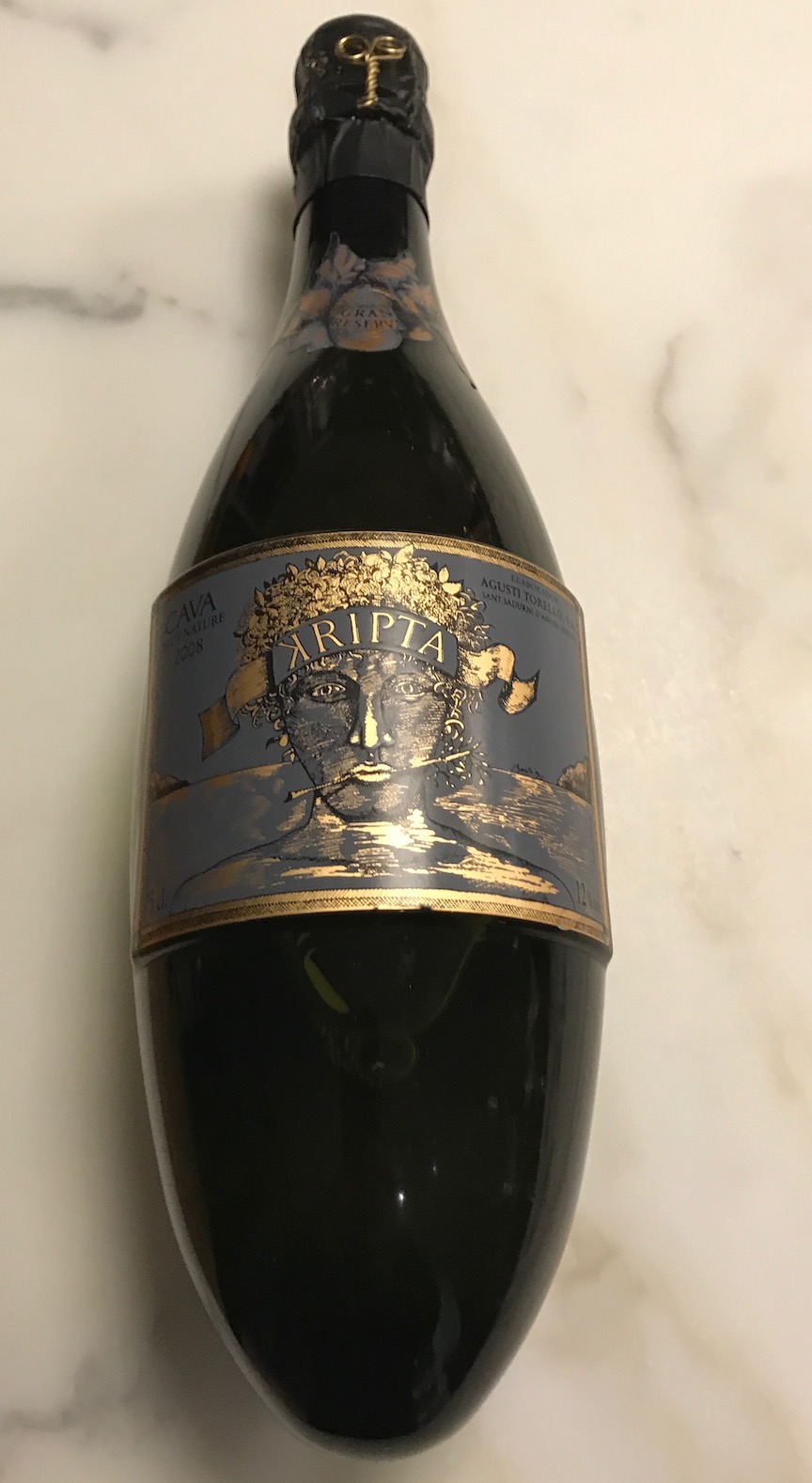
2007 Kripta Agustí Torelló Mata Cava Kripta Brut Nature Gran Reserva.

Brought by my good friend Gino this amazing sparkler is a blend of Macabeo,Xarello and Parellada grapes.  It is considered by many to be Spain’s greatest sparkling wine.  A little research provided the following: "1979 in the cellar of Can Rossell KIPTA is born. After 32 years of experience Agusti Torello Mata decides to realize his illusion. KRIPTA comes from the best old vineyards of Penedés, an exceptional blending of the best plots of Macabeo, Xarel·lo and Parellada.  A long aging with a cork stopper of at least 5 years, they get a unique bouquet that consolidates it as one of the great wines of the world.  The bottle, reminiscences of Roman amphora, and the label-work of the artist Rafael Bartolozzi- are the touch of final elegance of this great wine cellar".

This was a full-bodied Cava with wonderful depth and an underlying citric palate.  It finished with with terrific length.


2007 Philipponnat Brut Royale Reserve Non-Dosé Champagne (Disgorged September 2011).

I purchased a few bottles of this amazing Champagne from The Rare Wine Company a number of years ago.  I recored these comments, which I believe are from their web site.  "When a bottle of Champagne receives its final cork, a little sugar ("dosage") is usually added to the wine.  Brut Champagnes can legally have up to 12 grams per liter added. But that much sugar typically means lower quality, as the producer may be hiding imperfections in the wine. In contrast, the dosage of an elite, flawless Champagne typically ranges from 4 to 7 grams. But few Champagnes are released into the world with no  dosage at all; most producers like the rounding effect that sugar has on even the best Champagnes. To succeed with absolutely no dosage requires a Champagne of unusual richness and roundness on the palate.


Philipponnat's Non-Dosé is such a Champagne. It was introduced in 2009 to great critical acclaim. And of all the reviewers who've praised it, we find the comments of Peter Liem (whose Champagneguide.net we highly recommend) particularly incisive:

"In the absence of dosage, the pinot fruit is strongly emphasized ... and it's the dark, virile fruit tones of the black grapes that dominate here, whereas in (Philipponnat's flagship Brut Royale Réserve) the chardonnay somehow makes its presence more clearly felt. This is impressive, showing a harmonious balance from beginning to end ..."

It is hard to believe that this only costs around $40.  It's yeasty bouquet and palate brings a lingering smile to those that sip it.

I was able to secure the private wine cellar dining room at LuNello’s Ristorante in Cedar grove for our dinner.  Chef/owner Lou Segar and his staff did a magnificent job with the accommodations, service and food.

1996 Giuseppe Mascarello Barolo Riserva Monprivato Ca’ d’Morisso, Magnum.  3 hour slo-o.  Awesome wine.  Round and delicious with great balance, depth, finesse and a monster finish.


2004 Soldera Case Basse Brunello di Montalcino Riserva.  Pnp.  I first tasted this wine from barrel when I visited Soldera in 2008.  The wine blew us away then and it did again tonight.  A sensational bottle of wine that has aged to perfection.  Elegance in the glass.  The wine soared with each sip and finished with great length.  It edged out the ‘96 Ca’d’Morisso as WOTN.


2002 Domaine Castagnier Charmes-Chambertin Grand Cru.  Pnp.  Excellent Burgundy from a producer I was not familier with.  Classic Burgundian nose and palate.  On another night could have been in the running for WOTN, but not tonight.


1995 Chateau d’Yquem Sauternes.  3-hour slo-o.  Gorgeous amber hue.  Palate of pure nectar, if only the finish was not so medicinal.


Christmas Day

We begin Christmas day with a terrific breakfast of scrambled eggs, pancakes, bacon and biscuits at our oldest daughter Gina's house, followed by opening presents with our adorable grandchildren.  We completed our Christmas celebration at our youngest daughter's house for dinner at night.  Lisa and Andy do a great job with a meal featuring steak and potatoes.

1990 Paul Jaboulet Ainé Hermitage La Chapelle.  It has been a long time since I had a bottle of this legendary wine.  The wine displayed amazing youth with beautiful balance and elegance on the palate.  The wine evolved with each sip and finished with great length.

2007 Armand Rousseau Chambertin Grand Cru.  3 hour in decanter.  Classic Burgundy.  A pure and elegant wine with terrific complexity, finesse and a lengthy and elegant finish.  At the beginning of what should be a long and enjoyable drinking window.  My WOTN.

2006 Rattalino Barbaresco Quarantatre 43.  Pnp.  Fermented in stainless steel tanks, this is an under the radar producer of traditionally made Barolo and Barbaresco that is always a delight to drink.  2006 was a great vintage in Barbaresco as was clearly evident in this wine.

1991 Quinta Do Noval Vintage Port.  A good, not great bottle of port that is approaching the end of its time.


It was another fabulous Christmas.  Carol and I are truly blessed to have such a wonderful family and friends to celebrate the holiday with.  We wish you and your families all the best for the holidays.


Saluté